Unit 4: Earth History
Fossils and Relative Dating
Fossils
At least 99% of the species that have ever been present on the earth are now extinct - in other words, there are no living representatives of that species present anywhere (the opposite of extinct is extant, which means that there are living individuals of that species present on the earth). How do we know about these extinct species? From the fossil remains that they left in the rock record. Fossils are used extensively to study ancient time periods. Not only can you identify an organism based on the type of fossil you have, you can infer the type of environment that it lived in. Fossils are any remains of an organism or its activities that are preserved in rock. The materials out of which organisms are made are well suited to the needs of the organism, but they usually are not that stable, chemically, in the external environment at the earth's surface. So, the process of fossilization - turning a dead organism into a fossil - involves a number of chemical transformations which replace the original minerals of the organism with new minerals, hopefully without losing too much detail in the process.
Fossilization Potential
The fossilization potential of an individual organism - the probability that any one organism will eventually become a fossil - is very small: much, much less than 1 %. This is bad for paleontologists (people who study fossils), but good for the environment and life in general. Any organism that becomes a fossil does not decompose to the same extent and so its nutrients are not returned to the biosphere. If even 0.01% of organisms were fossilized, the biosphere would run out of vital nutrients in a matter of a few years. Not only that, but we would be neck deep in partly decomposed bodies.
How "poor" is the fossil record; i.e., what proportion of living things get preserved? If the history of life was a book, then only a couple of words per chapter would be preserved. Not enough, you might think, to even get a rough idea of what the story is about! Fortunately for us, the book is, in fact, a very large library with a great deal of repetition. So, even a few words per chapter gives us a complete enough picture to work with, if we are careful to ask the right sort of questions.
Fossilization potential is different for different types of organisms: organisms with robust, thick skeletons are more likely to fossilize than those with small, delicate skeletons. Any organism with a skeleton (bones, shells, scales, teeth) has a better chance to fossilize than an organism with no skeleton at all. Different environments also affect the fossilization potential. If an organism lives in mountainous habitats or in fast-flowing rivers it is unlikely to fossilize as erosion and vigorous sedimemnt transport will expose and destroy any remains of an organism. Organisms that live in deep ocean basins that can settle down to the ocean floor and get covered by muddy sediment have a much better potential to fossilize. Therefore, out view of ancient life is biased towards certain types of organisms: those with certain body designs and which live in certain environments. We need to keep this in mind when we are interpreting the fossil record.
Types of Fossils
There are several ways of preserving an organism as a fossil.
- Original Remains
It is very rare that the entire body of an organism is preserved. Soft tissues usually decay very quickly, even before they can be buried, leaving behind only the hard parts of an organism. However, there are certain environments that are favourable for preserving an entire body. Here are some examples:
- organisms that fall into peat bogs or tar pits (both are very low in oxygen and peat bogs are too acidic for most bacteria)
peat bogs can preserve soft tissues, such as this 2000 year old human corpse, but usually dissolve mineral components such as the bones
- insects that are trapped in tree resin which hardens to amber
- organisms that are frozen, usually in permafrost
This form of preservation is useful for biochemical investigations of ancient organisms as the DNA, proteins, and other molecules can remain largely intact. We really might find examples of dinosaur DNA in this way, but hopefully we will not make any dinosaur zoological parks!
- Replacement (Petrification)
Replacement occurs when the original minerals of a shell or bone are replaced by different minerals which are chemically more stable. These new minerals are carried as dissolved material through rocks and sediments by groundwater. Original shell and bone minerals can be replaced by silica (a non-crystalline form of quartz), calcite (most organisms with a calcium carbonate shell use a less stable form called Aragonite) or pyrite (also called fool's gold). An example of a fossil preserved in this way is petrified wood. The original woody tissue is replaced by silica, which is much more resistant to weathering and erosion and is not subject to organic decay.
Many of the shelly fossils in our local limestone formations also are preserved as silica. This is helpful to fossil hunters because limestone chemically weathers away with acid rain, but silica does not so the fossils stand out at the surface of the rock over time.
The process of petrification occurs very slowly. The original mineral and the replacement mineral are in a state of near chemical equilibrium so the exchange of minerals is on an atom-by-atom scale. Because of this, very fine external and nternal skeletal details (including spaces for blood vessels, for example) often are faithfully preserved. In some environments, the protein matrix within the bone or shell minerals is preserved and some biochemical analysis of the original organism can be conducted. For example, a comparison of the internal structure of dinosaur bone (blood vessels and other details) with bones of modern birds and dinosaurs comfirmed the idea that dinosaurs probably were more like active, warm-blooded birds than modern reptiles.
- Molds and Casts
A mold is a void in a rock that bears the surface features of an organism that results from the dissolution of the original shell after the surrounding sediment has fully or partially lithified. This gives way for other minerals to enter through pore spaces in the rock and precipitate into the mold to create a cast. Molds may be filled to form casts with sediments or minerals.
Use this link to observe the formation of a cast and mold.
Moulds and casts may faithfully replicate surface features of the original bone or shell, but not the internal features.
- Trace Fossils
Trace fossils provide indirect evidence of an organism. They include any impressions left by an ancient organism and provide evidence of either structure or behaviour. Examples of trace fossils include coprolites (fossil feces), bite marks, burrows, and footprints.
Trace fossils provide excellent ecological data because, unlike the bodies of organisms, a track cannot be moved after it is made without destroying it. Therefore, if you find a track, the rock in which it is found always is representative of the environment in which the organism lived. Body fossils often are deposited far from where the organism actually lived. Another ecological advantage is that the behaviours that are taking place in an environment often are more indicative of the type of ecosystem than the identity of the organisms.
- Carbonization
Many remains of plants and animals are buried under conditions of high temperature and pressure and their more volatile components have been squeezed out through sediment build up. A thin film of carbon is left preserved between the rock layers. This is very common for plants and graptolites (a type of planktonic (small, free floating) organism that lives is small colonies.
Summary
View this animation of the formation of various types of fossils.
Check out the Museum Victoria Invertebrate Fossils website for a summary of the different invertebrate animals groups that are common in the follsil record (invertebrate = no backbone; exlcudes fish, amphibians, reptiles, birds and mammals). Most of the fossils we find are invertebrates. While they do not have the same internal bony skeleton and vertebral column ("back bone") that we have, they do have mineralized skeletons, often on the outside of their bodies rather than the inside (examples include the shells of clams, the external skeleton of crustaceans (e.g., shrimp and crabs) and insects). These exoskeletons have a good fossilization potential. In fact, the first era of the Phanerozoic Eon, the Paleozoic Era (age of ancient life), often is referred to as the age of invertebrates.
Faunal Succession
Organisms are classified based on their structural characteristics. By looking through the geologic record, we can see that organisms evolved from very simple one-celled creatures to being multi-cellular and much more complex in terms of both structure and behaviour (as shown by how trace fossils change over time). The following chart outlines some of the large-scale generalizations can be made concerning the patterns of life that we see in the principal periods of time in the fossil record:
| Cenozoic Era |
birds dominate early in the era, mammals later on; grasses and flowering plants; beetles and bees |
| Mesozoic Era |
large reptiles (especially dinosaurs), conifers |
| late Paleozoic Era |
large, mammal-like reptiles; large ferns and other primitive plants form large forests |
| middle Paleozoic Era |
fish, first land plants and animals (amphibians, insects) |
| early Paleozoic Era |
complex multicellular organisms (complex trace fossils are found) such as trilobites and simple fish |
| late Proterozoic Era |
simple multicellular organisms with simple muscle and nevous systems (as evidenced by the lack of complex burrowing trace fossils) |
| early Proterozoic Era |
photosynthetic algea appeare (oxide minerals show that the atmosphere becomes oxygenated) |
| Archean Era |
single celled organisms |
A more detailed picture of the succession of life through geologic time can be found in the University of Califirnia Museum of Paleontology virtual time machine.
Index Fossils and Relative Dating
Index fossils are very useful for geologists who are trying to determine the age of rocks. The principle of fossil succession states that any time period can be determine by its unique fossil content. The process of biological evolution ensures that species change their structure at frequent intervals and that species become extinct and new species are produced. Thus, once the species of a given time interval have been characterized in one location, the presence of those same species in the rocks at any other location suggests that those rocks were deposited during the same time interval as the fist location. The passage of time in the rock record can be marked by the vertical transition from one assemblage of fossil species to another. It is important to remember that the time information given by fossil data is relative. Unless there is a radiometrically dateable volcanic ash associated with a certain fossil species, fossils cannot be used to attribute an absolute age to a rock layer. However, since most species last only a few million years at most before going extinct, fossils can be used to mark the passage of geologic time fairly precisely compared to radiometric dating.
Unconformities
Once a sequence of fossil types has been recognized (species A --> species B --> species C --> species D), breaks in this sequence at other locations can mark the presence of unconformities - gaps in the sedimentary rock record. If the sequence of species at a different location is species A --> species C --> species D, then the missing species B indicates that there is a period of time when sediment was not deposited or eroded which coincides with the time during which species B existed.
Index Fossils
Not all fossils are useful for correlating a specific time interval between different locations. Those that are are called index fossils. Index fossils are those of species that existed for a relatively short span of time before going extinct or before exhibiting characteristics that make one generation distingishable from previous and subsequent generations. In other words, they were a rapidly evolving species. The following are characteristics of good index fossils:
- they are easily recognizable and distinguishable from all other fossils (they have a lot of specific details that are diagnostic of that species)
- the specific identifying details should not confer a strong adaptive advantage: i.e., we want an evolutionary squence that is non-convergent.
- were extant for a very short time period before being replaced by different species
- have a wide geographic distribution
- are abundant
- occur in a wide variety of different sedimentary rock
- have a good fossilization potential (hard skeletal parts)
Index fossils typically were organisms that swam or floated passively in the ocean and so could be distributed over a wide area. When they died, they would sink to the bottom and would be preserved in what ever sediment type was under them at the time. Fossils of organisms that lived in certain environments on the ocean bottom would only be found preserved in those sediment types and would not be useful for correlating time periods in any other sedimentary rock type. However, even organisms that live on the ocean bottom can be useful as index fossils. Many ocean-floor-dwelling invertebrates have a larval life stage in which the organism is free-swimming or is planktonic (floats in the water and goes wherever the current takes it). If these species also lived on a variety of sediment types, they could still produce useful index fossils.
Some Typical Index Fossils
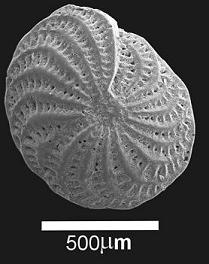 |
Foram: a microscopic shell made by single celled amoebas.
The small openings in these microscopic shells are for the amoeba pseudopods to extend beyond the shell. They result in considerable amount of fine detail on the shell wall which varies from species to species. |
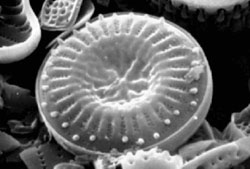 |
Diatom:, a microscopic shell made by a single celled algae.
These micoscopic shells also diplay a wide variety of detal on the shell surface. |
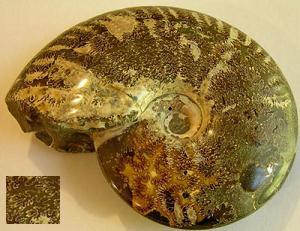
This shell is approximately 20 to 25 cm across.
The external shell has dissolved away. What is present is the sedimentary rock that filled in the chambers and the folded walls between each chamber. |
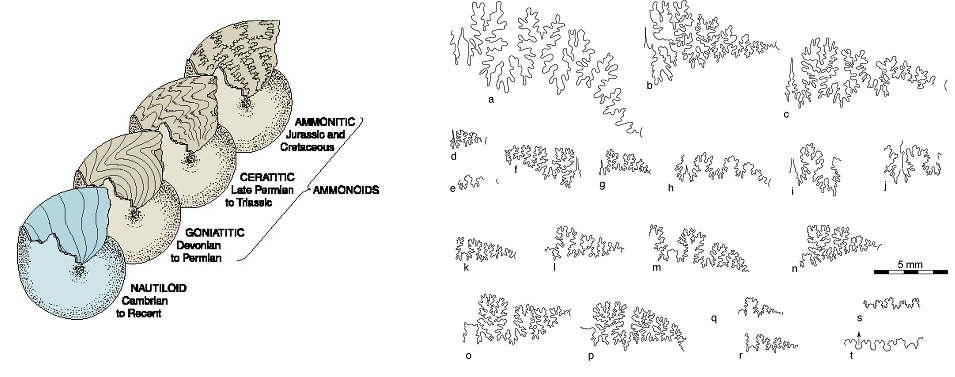
an Ammonite shell. Ammonites were Cretaceous relatives of the modern Chambered Nautilus. Unlike the nautilus, this ammonite does not have a rounded shell and so its shell had to be supported from within against water pressure (shells with circular cross-sections, like a submarine, are self-supporting). The support came from the walls between the chambers which were intricately folded back and forth to hold up the maximum outer shell area (see inset picture). The pattern of folds is diagnostic of different species.
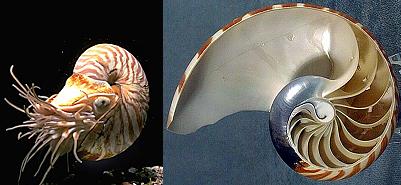
A modern chambered nautilus.
 |
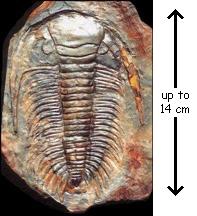 |
Paradoxides, a common trilobite in the middle Cambrian period. Trilobites exhibited a wide variety in their shape and and in the ornamentations on their exoskeletons (spines, bumps, etc.) which allow for easy species recognition. |
Biostratigraphic Correlation
Details of the technique.
Facies Fossils and Paleoenvironments
Fossils can also be used to infer the types of environments that once existed, a paleoenvironment. If we look at modern day organisms, we know that certain organisms can only tolerate specific environments. For example, corals are found in warm oceans and seas. The Niagara Escarpment is home to many types of coral fossils. Ancient corals would suggest that the area was once covered by a warm sea, which in fact it was. The sediment types of an area can also provide clues about the ancient environment. Fossils of organisms which lived only in specific environments and whose presence can reliably be used to infer a certain environment or environmental condition are referred to as facies fossils. Trace fossils usually are excellent facies fossils. Facies fossils can be used to:
- correlate rock layers between locations
- determine paleoenvironments: whether the area was marine or terrestrial at a certain point in time
- investigate paleoecology: how an ancient organism may have interacted with its environment
- investigate paleogeography: how landmasses were distributed throughout history
- investigate paleoclimates as many types of fossils only are abundant in certain types of climates
Other Relative Dating Events
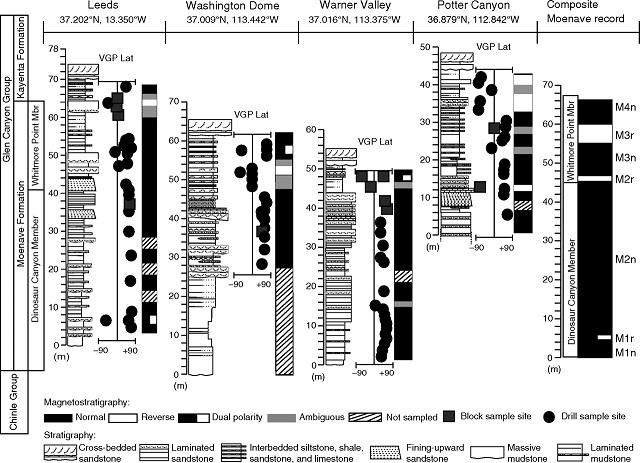
- Magnetic reversals.
The patterns in magnetic reversals (direction and duration) provide reliable horizons for dating.
- Volcanic and impact events.
Ash layers and impact fallout often contains identifiable trace materials.
An added advantage is that some of the minerals can be radiometrically datable.