By Jeffrey Martz
Layers of sedimentary
rocks, or strata, are stacked in vertical sequences, with the oldest layers
being on the bottom, and getting younger as we go up through the layers.
Remember that the study of the sequence of layers of strata is called
lithostratigraphy, and the study of the sequence of fossils
in these same layers is called biostratigraphy. Both of these
studies were pioneered in the early 19th century by a British geologist named William Smith, who
was one of the very first to figure out that you could identify the same
sequences of rocks and fossils in different parts of England (an excellent book
about Smith and his life is The
Map That Changed the World by Simon Winchester). Smith was primarily
interested in the economic benefits of these observations, and was able
to use his knowledge of the sequence of rocks and fossils, and how they
were distributed across England, to inform land owners whether or not
they could find coal or building stone on their property. What
Smith did not fully appreciate during his lifetime was that he had
also figured out the primary methods that geologists would use to
reconstruct the history of the Earth and its living organisms, right up to
present day.
If
you can observe the vertical order of strata in a particular area, such as the
Colorado Plateau, figuring out the relative ages of sedimentary rocks (and they
environments they represent and fossils they contain) is easy. What about
rocks in different parts of the world? If I have two vertical sequences of
strata in different parts of the world, how do I know if one sequence
is older than the other, or if they are the same age? The primary method
for doing this is called biostratigraphic
correlation, and it works by identifying similar fossils, and
similar sequences
of fossils, in different areas. The basic assumption of
biostratigraphic correlation as a method of determining relative ages is that
identical fossils in
different areas are probably about the same age (I'll talk more
about this assumption below). It works like this:
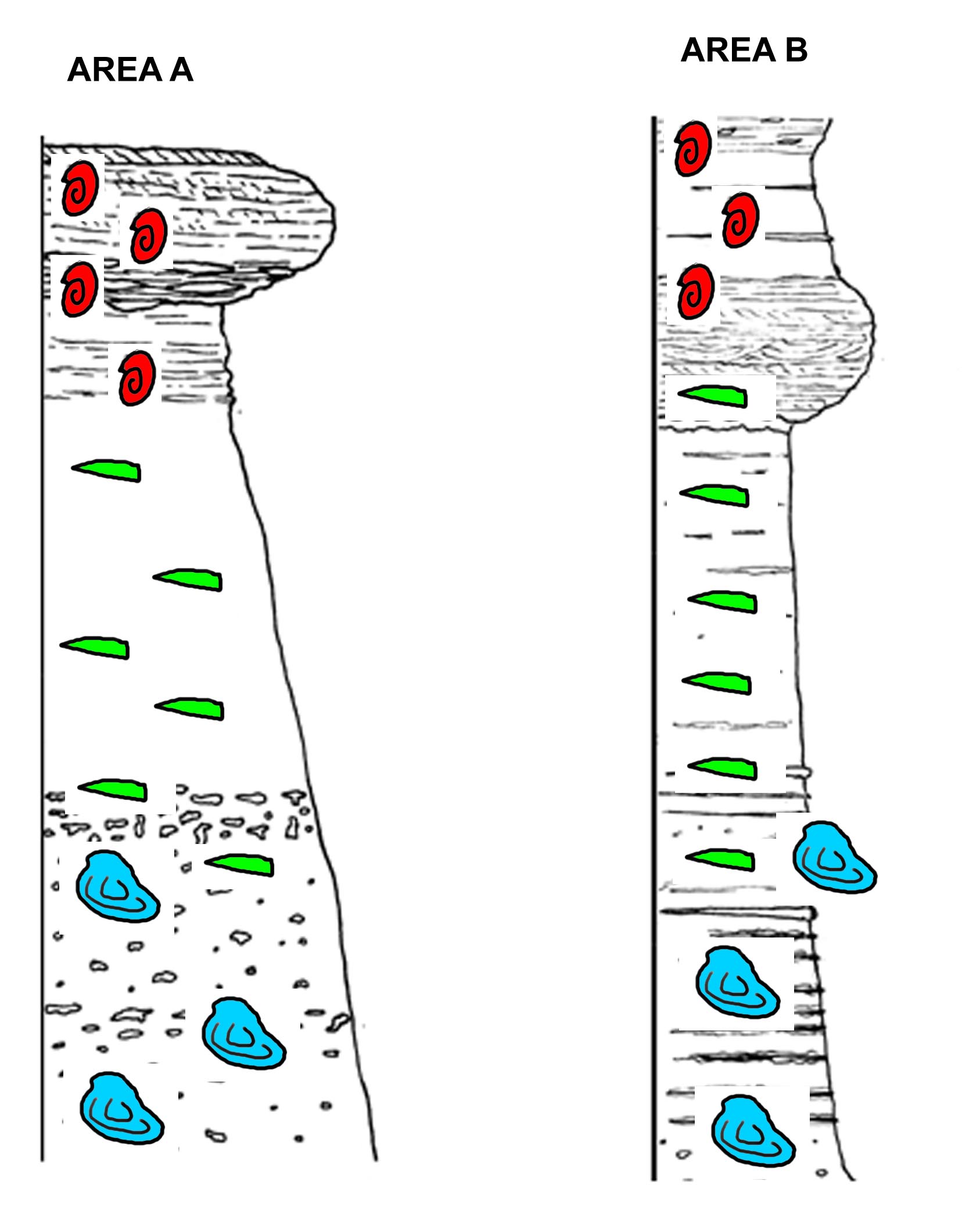
Here are two stratigraphic sections (diagrams showing a series of strata stacked on top of each other), which show the fossils contained in the strata. We already know from the Law of Superposition that the blue fossils in each section are older than (most of) the green ones, and that the green ones are older than the red ones. Notice also that the highest blue fossils and lowest green fossils occur in the same stratum (sediment layer). So, the story told in both sections is: 1) the blue fossils lived first, 2) the green fossils appeared at the same time as the last blue fossils (so they co-existed for a little while), 3) the blue fossils disappeared, 4) the green fossils disappeared, and 5) the red fossils appeared last. Pretty straightforward.
Now, using the assumption given above (that the same fossils in different areas are the same age), we can correlate between sections (identify equivalent strata) by identifying the levels in both sections where the same fossils appear and disappear. These allow us to subdivide the strata into units called biozones, with the appearances and disappearances of fossils as the boundaries:
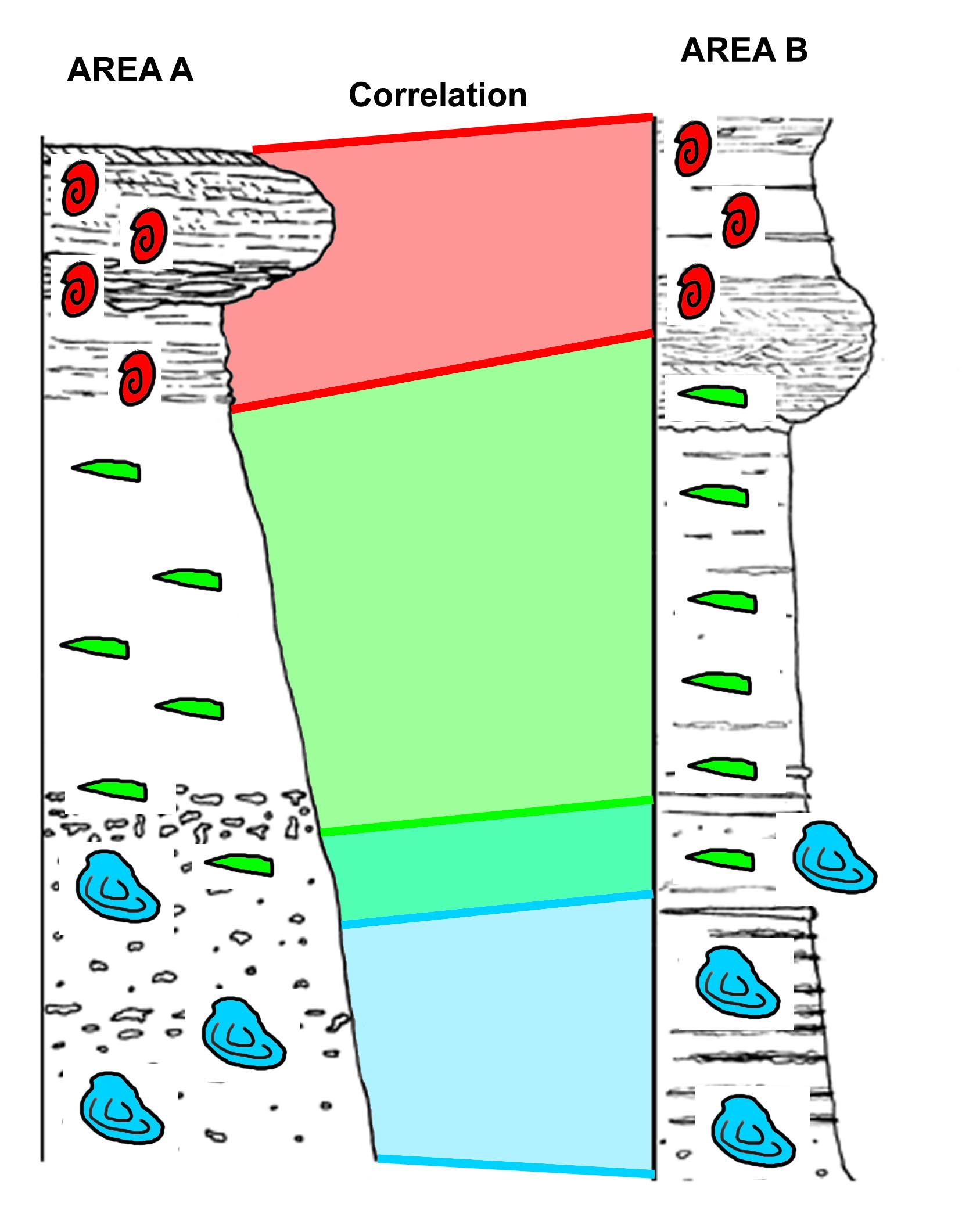
Notice that most biozones contain only one characteristic fossil, but that we can also define one containing two fossils (the blue oyster and green belemnite) bounded on the appearance of one and the disappearance of the other. If we assume that the same biozones in different areas are the same age (i.e., that the same fossils appeared and disappeared in both areas at about the same time; again, I'll discuss this assumption below), we have now learned a little bit more then we knew before. We know for example that the strata in the blue oyster zone in Area B are older than the strata in the red snail zone in Area A.
However, it is possible to learn a lot more. Let's now add two more sections from two different parts of the world:
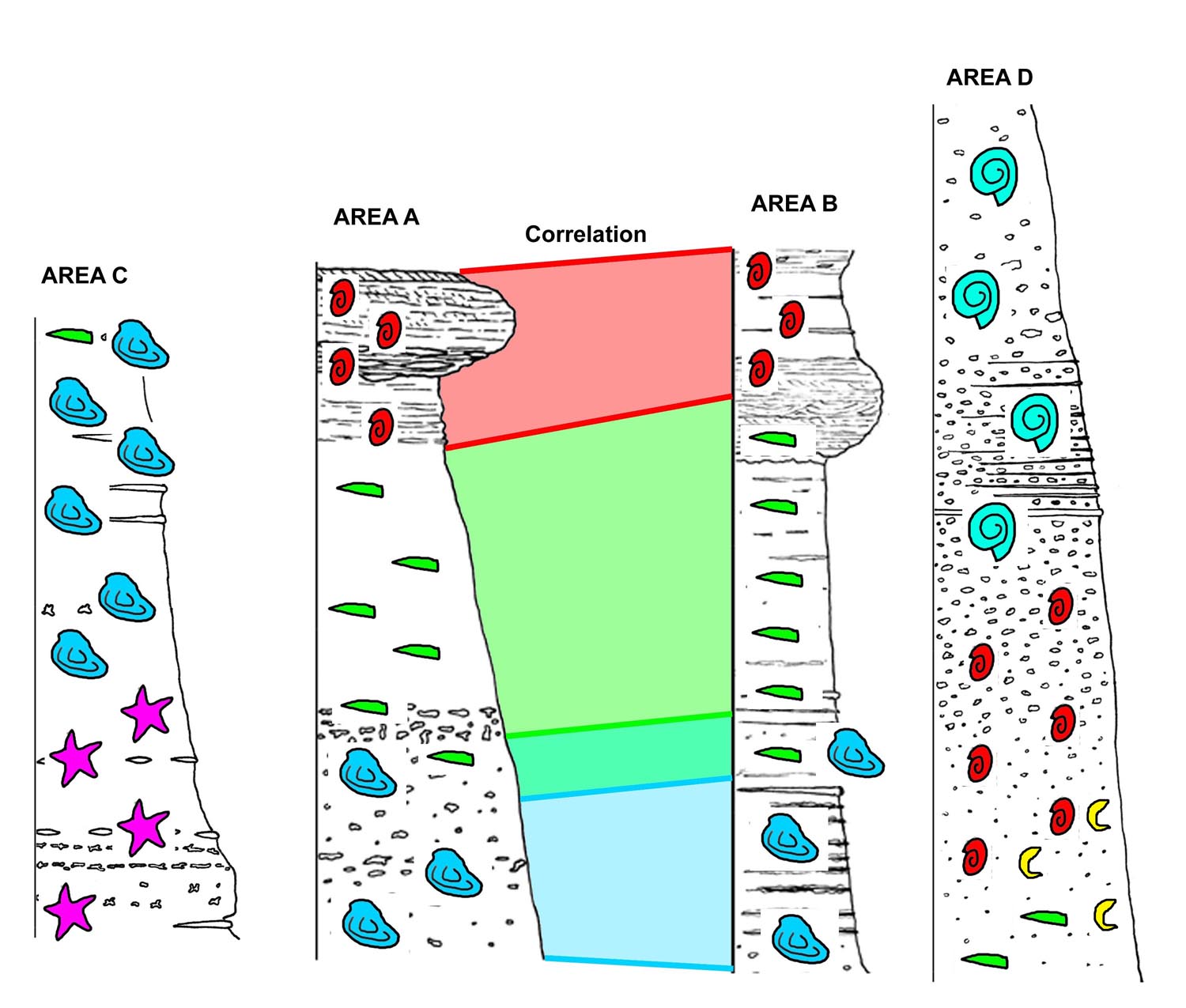
Notice that the blue oysters from Areas A and B also appear in Area C, that the red snails from Areas A and B also appear in Area D, and that the green belemnites (the pointy fossils) from Areas A and B appear in both of the new sections. However, we have some new information. We see that in Area C, a purple starfish appears below the blue oysters and that in Area D, a blue snail appears above the red snails. Area C and Area D respectively seem to be showing us rocks older and younger than we have seen before. Also notice that in Section D, there is a yellow coral (the "C"-shaped fossil) which occurs with the highest green belemnites and lowest red snails. We didn't see this yellow coral in Areas A and B, so it may have lived only in Area D. Let's now use biostratigraphic correlation to tie all four sections together:
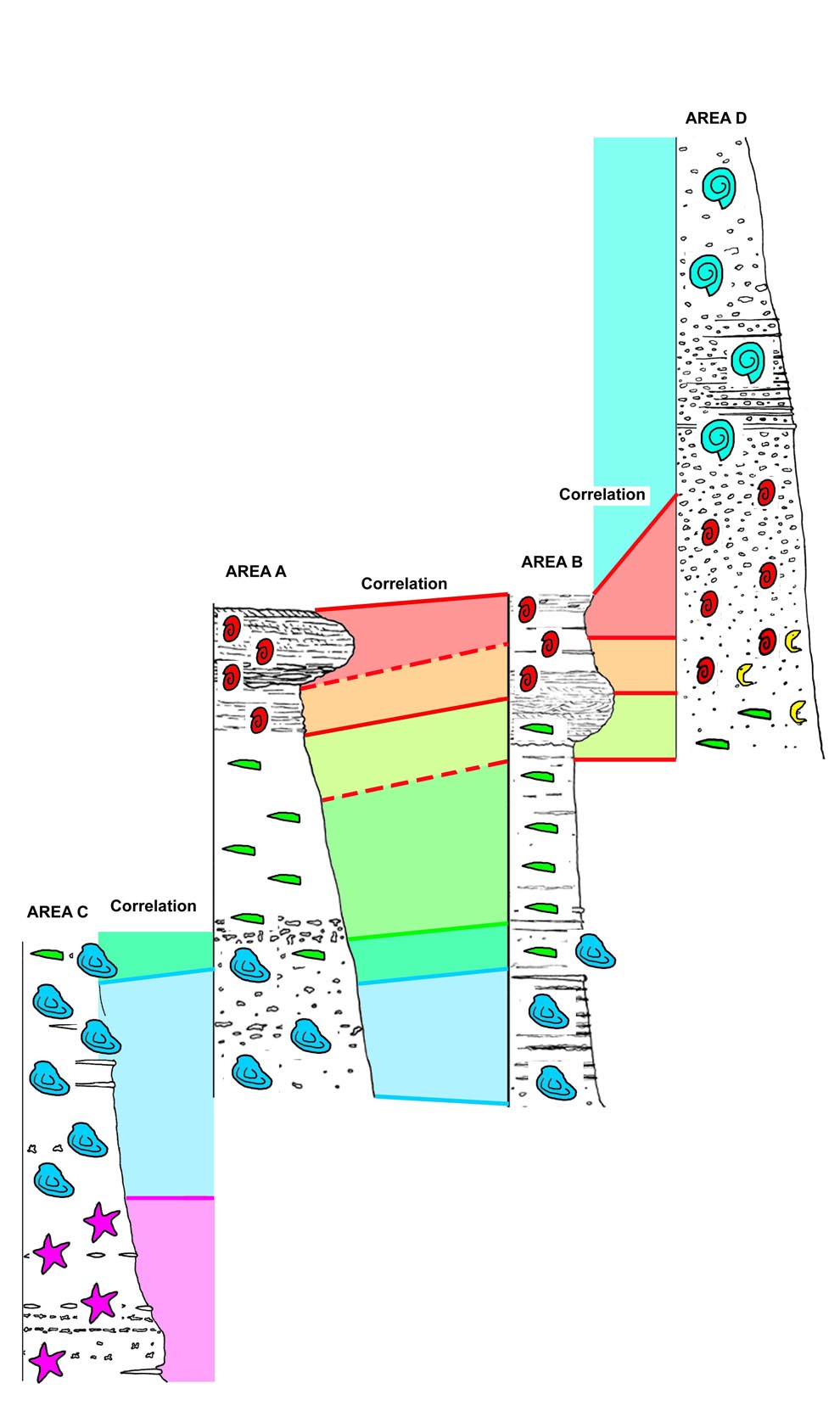
Notice that we can recognize two different zones in Area D using the yellow coral using appearances and disappearances, but that we have to approximate where the boundaries to these zones are in Area B. In other words, we identify roughly which strata were probably being deposited in Area B when the coral moved in and out of Area D based on where these events occurred in Area D (late in the range of the green belemnite, and early in the range of the red snail).
To simplify things a bit we can now put together a composite time chart showing the order the different fossils appear in, divided up into biozones:
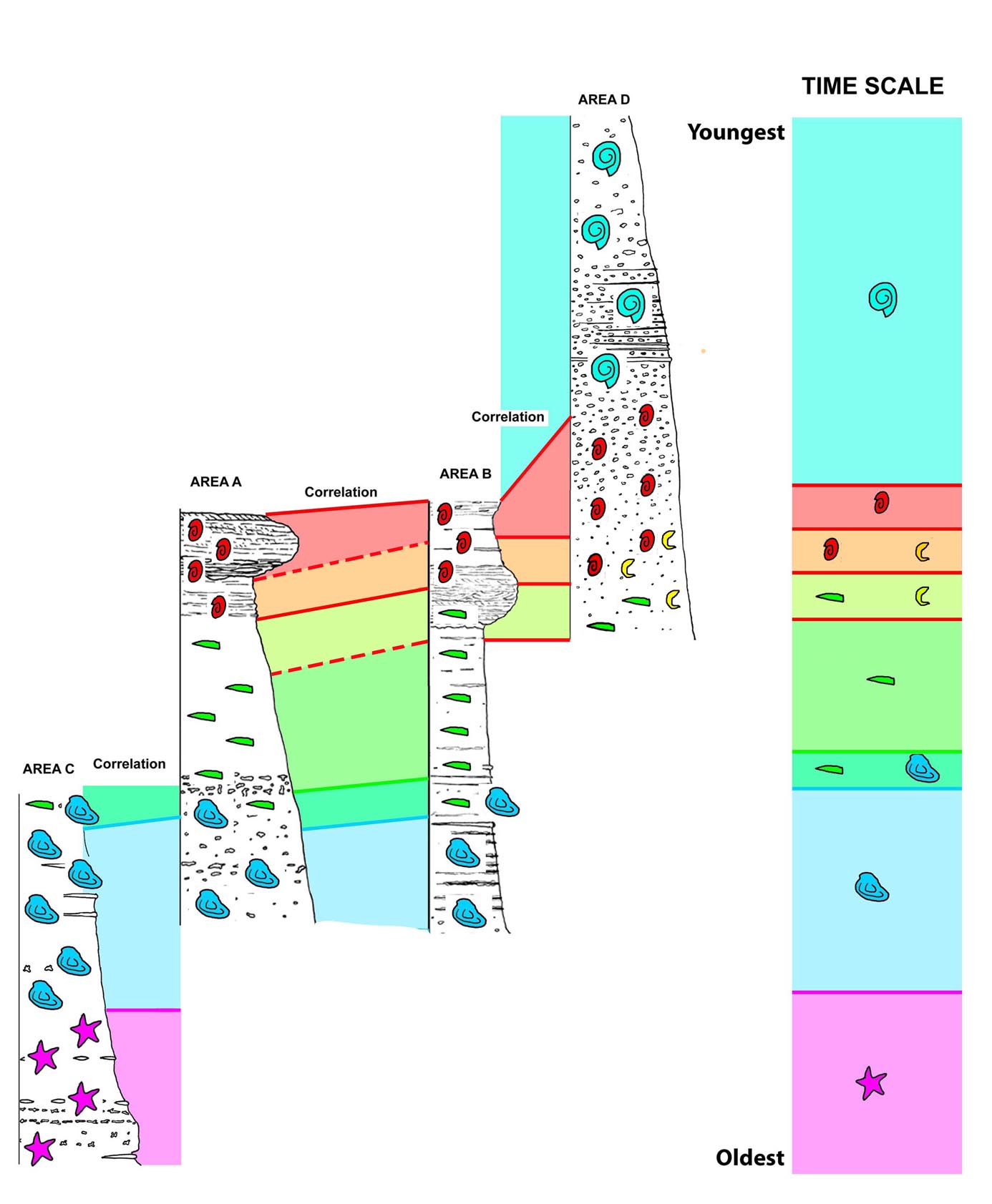
We could continue to expand this composite time column in the same way, using similar fossils from around the world to link strat sections together until we had a complete composite history of life. This is exactly what geologists have done over the past 200 years. The result was the creation of the geologic time scale, the basic framework for which was in place by the mid-19th century. This time scale divides up the history of the Earth into a few really big chunks of time (eons), which are in turn subdivided into increasingly small units of time (eras, periods, and epochs)...all based almost entirely on fossils. Here is a simplified version of the geologic time scale:
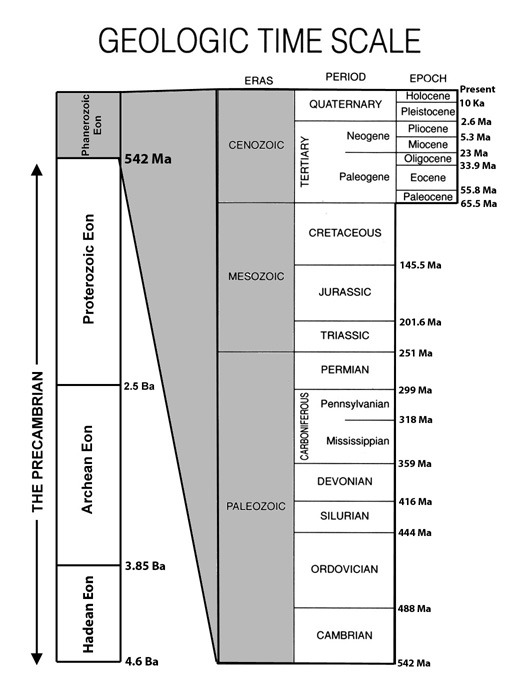
This scale has been simplified a bit; although epochs are shown only for the Cenozoic Era, all the periods have them. Although the numeric dates (which I'll talk about in the next post) shift around a bit, the basic framework, based on fossils, has changed little in the past 150 years.
Geologists and paleontologists primarily use the fossils of marine organisms like corals, cephalopods (squid and their relatives), and microscopic plankton to correlate strata; marine organisms tend to have an easier time dispersing across the entire world since the oceans and seas are almost all connected, and as a result the same (or at least, closely related) species may be found in completely different parts of the world. Land-living species have a harder time dispersing, since they have to cope with more geographic barriers like mountains and oceans. However, as the remains of land organisms (most commonly plant pollen) get washed into the oceans and are found with marine organisms, they can get tied into the composite time column as well.
Let's talk briefly about the assumption on which biostratigraphic correlation in based: how can we be sure that when we find the same fossils in different areas, that they are really the same age? After all, don't we have organisms around today that are "living fossils" and have been around for millions of years? Well, yes and no. There are groups of organisms which last for many millions or even (in the case of bacteria) billions of years, but individual species do not. This is also part of the answer to the common creationist question: "if we are descended from apes, why are there still apes around?" The answer is "because we aren't descended from modern day apes". Rather, modern apes and humans (which are apes too...deal with it) are descended from ape species which are now extinct. Fossil apes we discover which live millions of years ago are different from modern species, and we can distinguish them looking at their bones (especially their teeth). The forms Dryopithecus and Sivapithecus lived in the Miocene epoch, and Pan (chimpanzees and bonobos) and Pongo (orangutans) are known only from the more recent Holocene and Pleistocene epochs. It is no stranger that humans and other apes can coexist than it is that you and your siblings and cousins can coexist.
Another important piece of evidence that individual species do not generally live in different places millions of years apart is the consistency in the overall sequence in which different species exist in different areas. Let’s take another look at our first correlation:
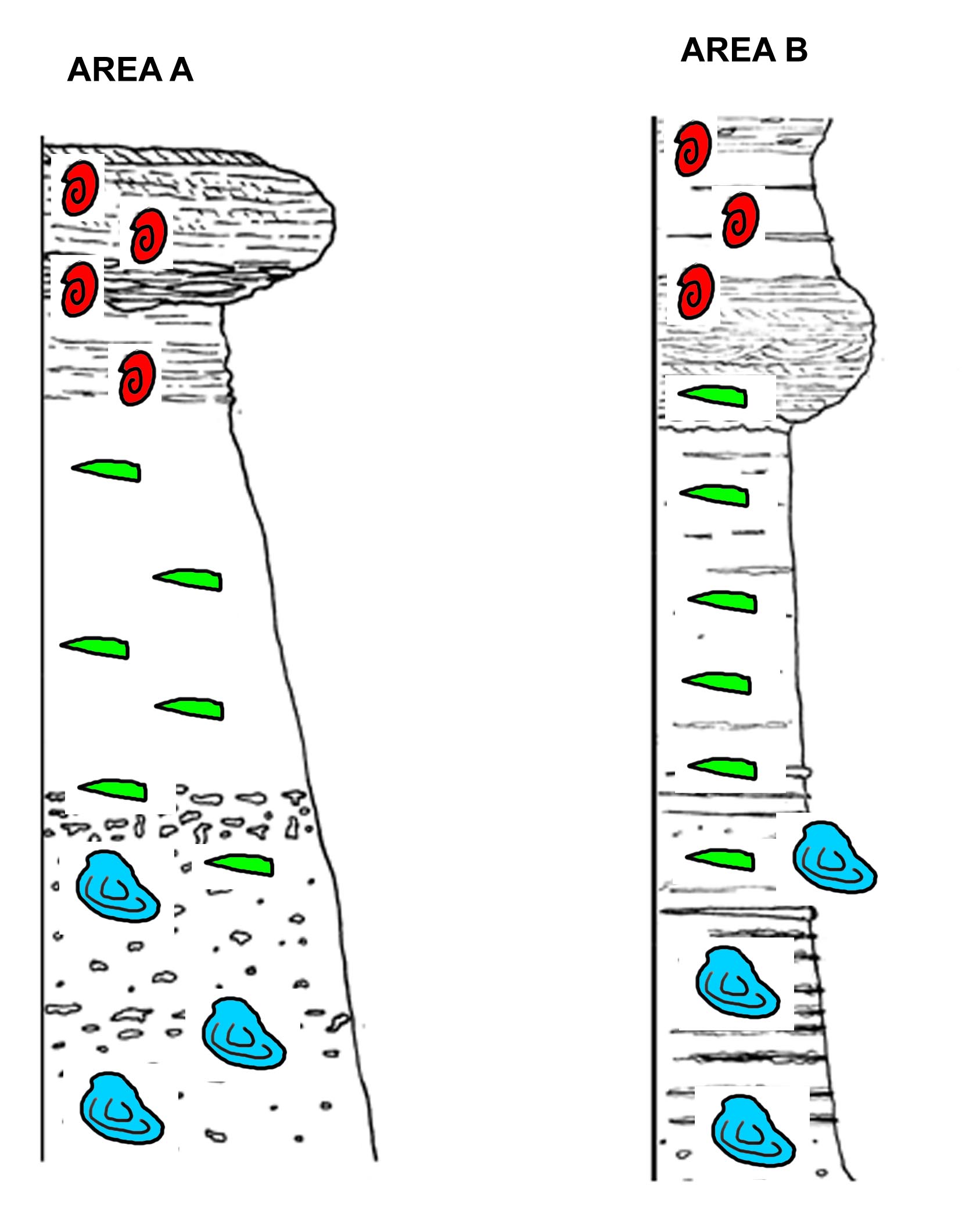
Now, in both hypothetical sections, we have an identical pattern of appearances and disappearances. Let's suggest, however, that the green belemnites lived much later in Area B than in Area A. However, if this is the case, then we would have to make similar adjustments to the ranges of the other taxa too. The blue oyster and red snail would also have to have lived later in Area B...otherwise there would be a big overlap between the green belemnites and the red snails, and a big gap between the green belemnites and blue oysters. This coincidence may be plausible just looking at two areas, but when we see similar sequences of fossils all across the world, in which species appear and disappear in the same order in different sections, it gets to be more and more of a stretch. Although slight discrepancies do occur (we could have overlaps occurring between species in some places which do not overlap in other areas), the overall patterns tend to be consistent between different areas. In the big picture of the history of life on Earth, these little variations don't amount to much.
Moreover, we can test whether or not individual species tend to occur over limited spans of time using a completely different and independent method: radioisotopic dating, the method by which we get numeric dates (in thousands, millions, and billions of years) for rocks and fossils. I'll talk more about how these are applied in the next post, but the important point for now is that the methods for calculating these dates are completely independent of biostratigraphy...and yet confirm that the relative ages of different fossils established by biostratigraphy are correct, with only slight differences in the local ages of the same species.