Structural Geology: Crustal Deformation
Structural Geology is the study of rock deformation.
Rock deformation (crustal deformation) is the response of the earth's crust to different forces that get imposed upon it. As we shall see in the next activity, these forces usually are connected with the motion of the earth's crustal plates (plate tectonics). However, there are other forces that can affect the earth as well, such as changes in the load on the crust from the accumulation or melting away of large ice sheets during glacial periods. The deposition or erosion away of ice or sediment can cause considerable flexing of the Earth's crust. This loading and unloading of the crust can produce some significant seismic events as well.
Crustal deformation responsible for most of the landmarks on our planet, such as mountains and rift valleys. Crustal deformation also produces the structures that allow for the accumulation of mineral resources such as oil and gas as well as precious metals.
Geologists refer to any force acting on the crust as a Stress
The resulting deformation in the rocks is referred to as a Strain
Stresses can be classified according to how they act on the rock:
| Stress |
Resulting Strain |
Example |
|
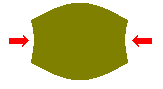
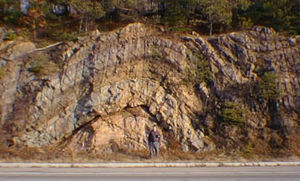
Compression (squeezing an object)
===> <===
|
 |
 |
|
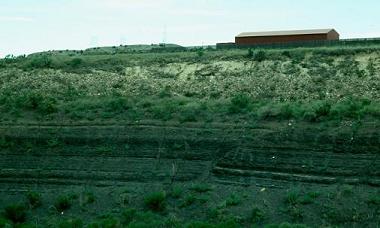
Tension (stretching an object)
<=== ===>
|
 |
 |
|
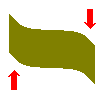
Shear (laterally offset forces)
<===
===>
|
 |
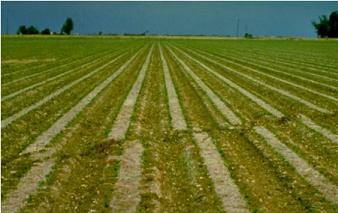 |
Geologists measure strain in the rocks so as to work out how the Earth's crust is behaving in any given location, both now and in the past. This allows them to predict what sorts of events will occur in the future. It allows them to better understand the mechanisms of plate tectonics and other processes that take place in the Earth. Folds and faults also trap hydrocarbon resources, so oil companies spend a fair bit of time working out the patterns of folding and faulting in areas where they are exploring for oil and gas.
Types of Deformation
There are two basic styles of rock deformation:
- brittle (cracking of the rock) and
- ductile (distortion of the rock)
Each of these two styles requires a certain set of temperature and pressure conditions. As an analogy, you might consider (or try it out) how butter would react to stress at room temperature as compared to when it is frozen. To consider the effects of pressure, imagine (or try it out) how a stick of butter would react to compression along its long axis if it was still in its paper wrapper or not. In general, brittle deformation takes place at lower temperatures and pressures (such as at the earth's surface where rock is very brittle indeed. Ductile deformation of rock requires that the rock is at higher pressure and temperature in order to avoid breaking. Thus, it tends to occur deep underground. Ductile deformation also requires lower stress. If rock is subjected to too high a rate of deformation it will fracture, even at great depth.
Within each of these two styles of deformation, there are different possibilities depending on the type of stress that is applied: compression, tension, or shear.
1) Brittle Deformation (faults and joints)
Joints are cracks in the rock across which no relative motion has taken place.
Faults are cracks in the rock across which relative motion has taken place.
In a fault there are two blocks of rock:
- the "hanging wall" is the rock above the fault,
- the "foot wall" is the rock below the fault.
- if you were standing on a fault below the surface, you would stand on the foot wall and the hanging wall would be hanging over your head.
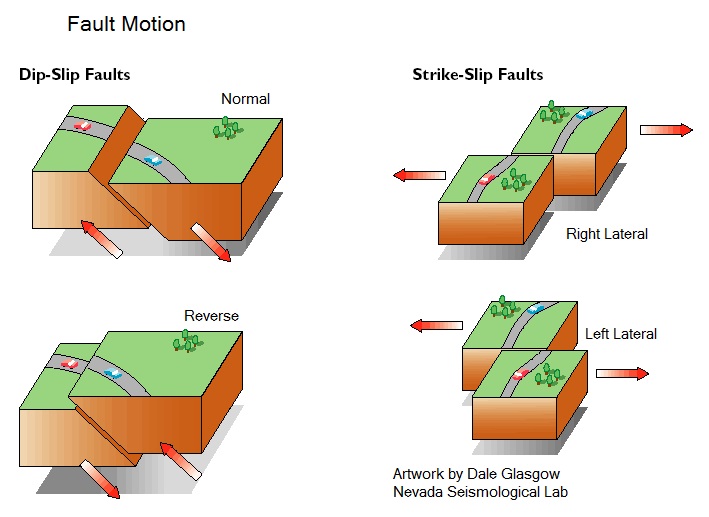
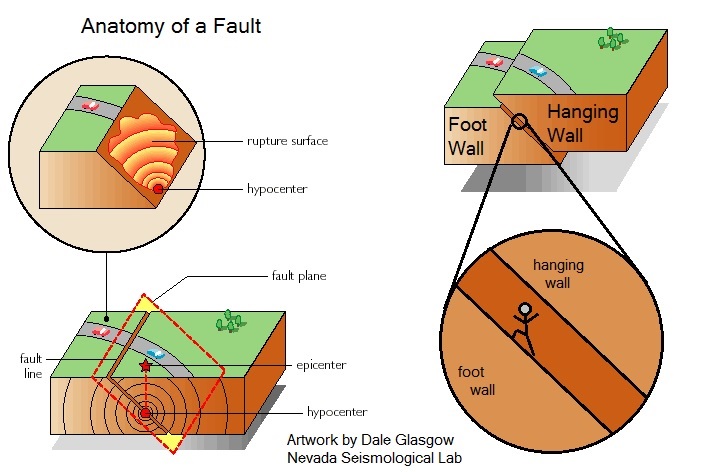 There are three main fault types:
- strike-slip faults (the two rock masses move horizontally) result from shear forces.
- normal faults (the hanging wall moves down) result from tension forces, and
- reverse faults (the hanging wall moves up) result from compression forces.
- There also are other varieties, such as Horst and Graben structures.
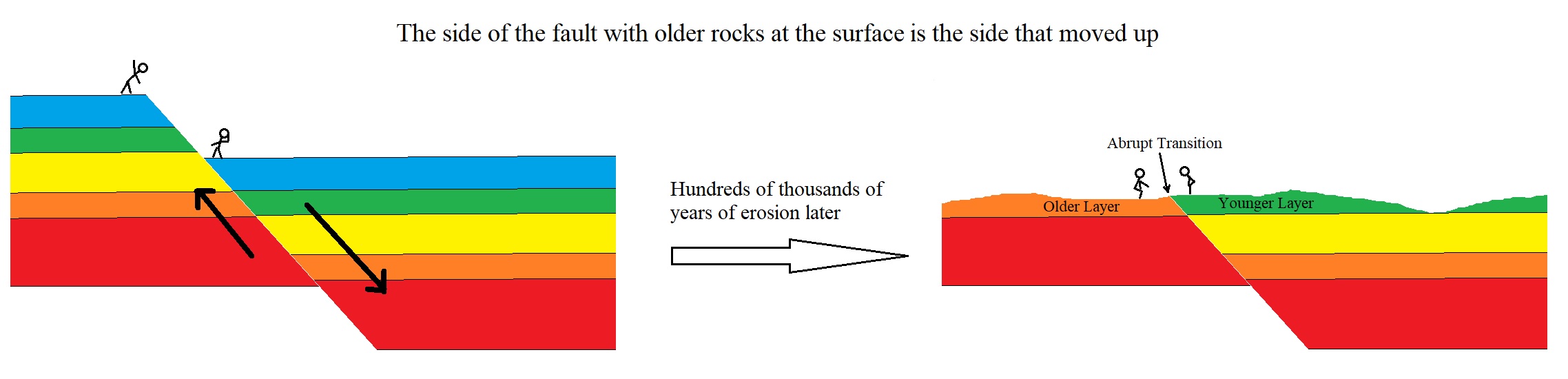
For a dip-slip fault, the way to tell which side of the fault went up is by looking at the age of the rocks on either side of the fault.
2) Ductile Deformation (folds, basins, and domes)
This type of deformation involves "plastic" bending, streching, and other forms of warping brought about by compressional stress.
Overview
The major types of ductile deformation are:
.
Recognizing Folds
As with all geological features, erosion wears away at the rocks and gradually flattens the features. Sometimes one can see the shape of a syncline or an anticline preserved, but more often all that one sees is a mirror image pattern of rock layers.
Anticlines- older rocks are found at the centre of the pattern
- rock layers tilt down away from the centre of the pattern
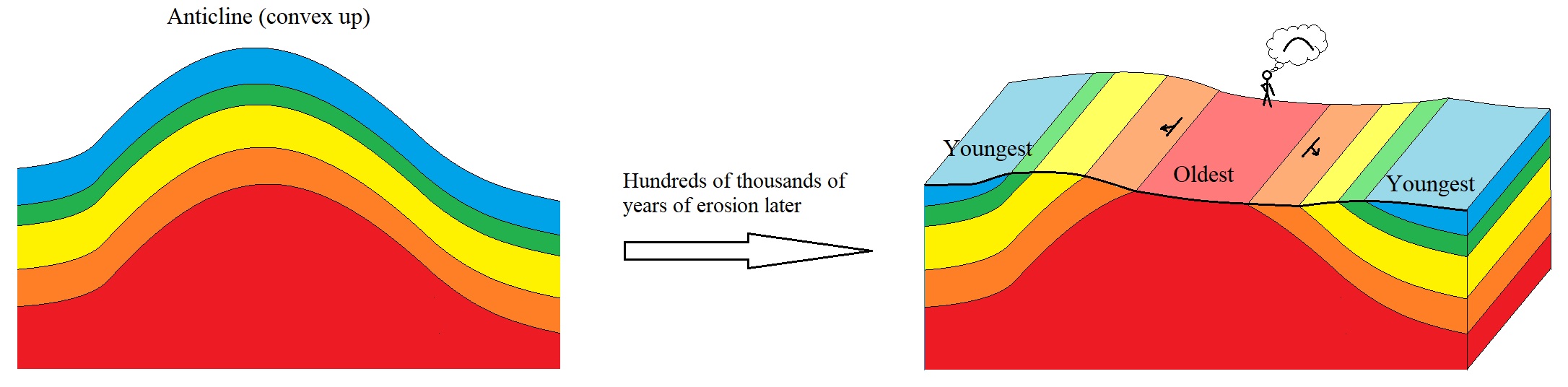
Basins show the same patterns, but in all directions
Synclines- younger rocks are found at the centre of the pattern
- rock layers tilt down towards the centre of the pattern
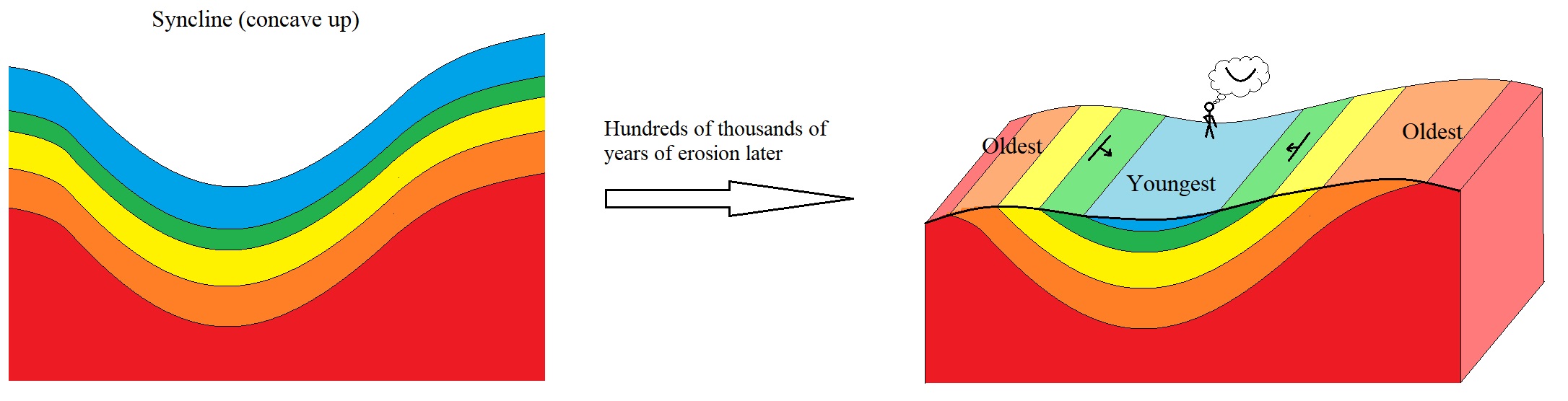
Domes show the same patterns, but in all directions
Questions to Consider
General
1) What is the difference between ductile and brittle strain?
2) What pressure and temperature conditions favour these two types of strain?
3) How might the rate of deformation affect which of the two styles takes place?
Brittle Deformation
4) How are joints and faults similar?
5) How are joints and faults different?
6) What are the two blocks of rock on opposite sides of the fault surface called?
7) How do these two blocks of rock move relative to each other in the three types of fault?
8) What are Horst and Graben structures?
9) Categorize the fault types listed in "Types of Deformation" into compression, tension, and shear.
10) What would you look for to recognize a fault in a rock outcrop or looking down at the ground from above?
Ductile Deformation
11) What features distinguish synclines from anticlines? Consider the orientation of rock layers and age.
12) Be able to sketch the parts of a fold.
13) What sort of stress conditions are needed to produce folds?
14) What situations might produce domes and basins?
15) How would you distinguish each of the structures in question 14 when looking down at the ground from above?
16) What sorts of features are produced by ductile tension and shear deformation?
Next Page