IGNEOUS ROCKS 2
Igneous Rock Classification
We are going to look at classifying igneous rocks according to:
- texture (grain size)
- chemical composition
We can then learn to relate these classes of rock to the depth at which the magma solidified and to the source of the magma (i.e., the plate tectonic setting: mantle hot spots, spreading ridges, and subduction zones).
Texture
We have seen that we can divide igneous rocks into intrusive and extrusive rocks based on the texture, which tells us at what rate the molten material cooled. The slower the cooling rate, the more time the crystals have to grow.
Review:
Intrusive Igneous Rocks
Intrusive, or plutonic igneous rock forms when magma is trapped deep inside the Earth. As magma rock rise toward the surface, some of it may feed volcanoes on the Earth's surface, but most remains trapped below, where it cools very slowly over many thousands or millions of years until it solidifies. Slow cooling (crystallization) means the individual mineral grains have a very long time to grow, so they grow to a relatively large size (at least large enough to be visible with the unaided eye. Crystals typically are interlocking with no void spaces between them. In addition, the long cooling process allows time for chemical reactions to occur between the crystals and the remaining molten rock.
Extrusive Igneous Rocks
Extrusive, or volcanic, igneous rock is produced when magma exits and cools outside of, or very near the Earth's surface. These are the rocks that form at erupting volcanoes and oozing fissures. The magma, called lava when it erupts on the surface, cools and solidifies almost instantly when it is exposed to the relatively cool temperature of the atmosphere. Quick cooling means that mineral crystals don't have much time to grow, so these rocks have a very fine-grained or even glassy texture.
In addition to rock material, large quantities of water vapor and other gases, which were dissolved in the magma, are vented from volcanoes. Hot gas bubbles are often trapped in the quenched lava, forming a bubbly, vesicular texture.
Ash is formed when viscous lava is blown apart into tiny shards. Ash is carried upwards by hot gases realeased from the lava and, depending on how high it rises, it can be carried tens of thousands of kilometres.
It can be difficult to identify specific minerals in these fine-grained volcanic rocks. Thus the overall colour of the rock is the primary means by which they can be classifed chemically.
Textural Classification
The two main classes are:
- Phaneritic: rock having visible mineral crystals.
- Aphanitic: rock having no easily visible mineral crystals.
In addition to these classes, there are the following:
- Vesicular: rock containing numerous cavities formed by gas bubbles that were preserved as the rocl solidified.
- Glassy: "rock" made up of transparent (although it may be very dark), amorphous material just like the glass made by people.
- Pegmatitic: rock with extremely large crystals (ie., really slow cooling). A survey of the literature suggests that most geologists would use this term when crystal size exceeds 2.5 cm.
- Porphyrytic: rock composed of large crystals surrounded by a aphanitic material. Both components result from the cooling of lava or magma.
- Tuffaceous: rock that forms from a consolodated ash. This rock type is fairly soft and usually has tiny void spaces between the ash particles. Because of the way in which it forms (consolidation of individual grains), this rock type straddles the boundary between igneous and sedimentary rock.
- Breccia: this is rock formed from fragments of material surrounded in a finer-grained material. The fragments usually are angular and may be of any rock type. The finer grained material can be either from ash or lava. It is different from a porphyry in that porphyritic rocks have all their components derived from the same molten material. Breccia fragments are picked up as already solid pieces from a variety of sources around the volcano.
There are quite a few common minerals found in igneous rocks, we have touched on only the very few most common examples. So, one might think that there would be a wide variety of different rock types. However, it turns out that there are relatively few common combinations of mineral types. This should be of some comfort of a budding geologist. It also is significant in that it suggests that there are some fairly simple chemical processes that control how minerals crystalize out of a molten state and a fairly limited number of sources for molten rock material.
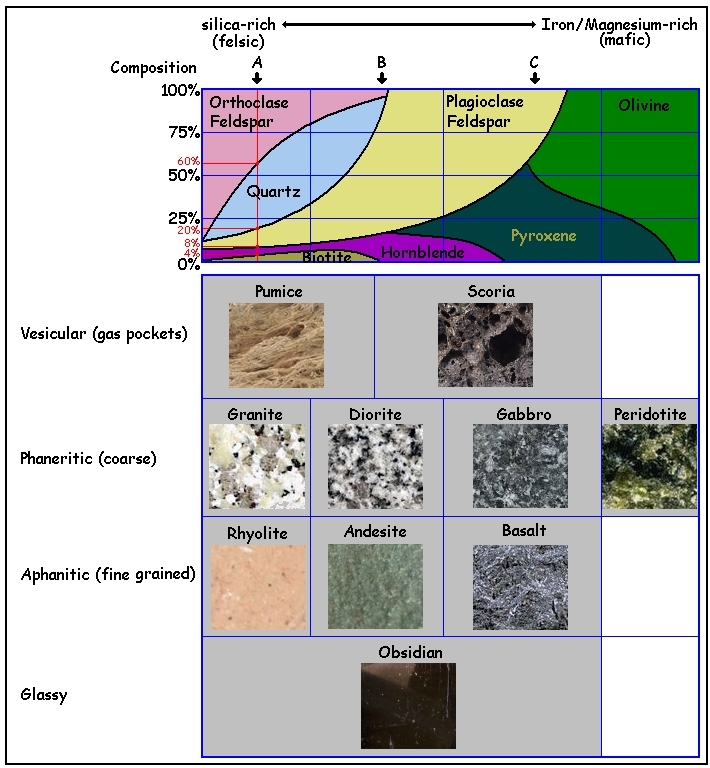
The following chart shows how the majority of igneous rocks can be classified.
How to read the chart above.
All of the common igneous rock compositional types are arranged along the X-axis of the top-most, rather colourful part of the diagram.
Pick any point at the top of the diagram and draw a vertical line down. The thickness of each mineral zone that your line passes through represents the proportional abundance of that mineral type in that rock type.
Examples:
Example A: reading up towards the arrow under the letter "A" we can see that this magma is about 4% biotite (0% up to 4% on the chart), 4% hornblend (4% up to 8% on the chart), 12% Plagioclase feldspar (8% up to 20% on the chart), 40% Quartz (20% up to 60% on the chart) and 40% orthoclase feldspar (60% up to 100%). Depending on how this magma cools, it could form a granite (slow cooling and solidification deep within the earth) or a rhyolite (rapid solidification at the earth's surface), or a silica-rich obsidian if it cools extremely rapidly (such as being extruded under water), or a pumice if its gas content is high enough.
Example B: reading up towards the arrow under the letter "B" we have a composition of 15% hornblende, 73% plagioclase feldspar, 6% quartz, and 6% orthoclase feldspar. This magma would form a Diorite if it crystalizes underground or an andesite if it is extruded.
Example C: reading up towards the arrow under the letter "C" we have a composition of 55% pyroxene, 10% olivine, and 25% plagioclase fleldspar. This magma would form a Gabbro if it cools underground or a basalt if it is extruded to the surface.
For any given rock in the lower part of the diagram, its composition can be determined by reading up from the lower box to the top of the upper box. As before, the relative thickness of each colour zone at that horizontal position on the chart indicates the relative proportion of the corresponding mineral. Each of the rock types shown in the bottom of the chart represents a fairly broad range of mineral compositions. For example, some Granites and more orthoclase rich and others are more quartz rich.
What this chart implies is that there are a limited number of combinations of mineral types that are found in natural igneous rocks.
For example, one can find rocks composed mostly of olivine with some pyroxene; rocks with mostly plagioclase feldspar, pyroxene, and hornblende, or rocks with orthoclase feldspar, quartz, and mica. But one never finds igneous rocks with significant amounts of olivine, orthoclase, and quartz. There is not vertical line on the chart that passes through those three mineral types and they are, indeed, not found in nature except for breccias and xenoliths (inclusions). When a rock cools from a magma or lava, those three minerals are never found together!
Felsic vs Mafic Rocks:
The first clue as to what is controlling the crystallization of igneous rocks is that the compositional categories along the top of the chart can be seen to separate Calcium-, Iron-, and Magnesium-rich mineral types (Mafic for Magnesium and Iron (Fe)) on the right-hand side of the chart progressing to more feldspar and silica rich rocks (Felsic) on the left-hand side of the chart. Thus, it is clear that the chemical environments favouring the formation of these two sets of minerals must be different.
Review:
Common Rock-forming Minerals
Quartz: a framework (3-D network) mineral of pure silica (SiO2)
Orthoclase Feldspar: a Potassium-rich framework silicate mineral
Plagioclase Feldspar: a Calcium/Sodium-rich framework silicate
Biotite: an Iron/Magnesium-rich mica (sheet silicate)
Hornblende: one of several different Iron and Magnesium-rich double-chain silicates
Pyroxene: one of several Iron and Magnesium-rich single-chain silicates
Olivine: a common isolated silica minerals, also rich in Iron and Magnesium
Each of these minerals (except for quartz) are representatives of a much larger group of similar minerals.
Mineral Composition Categories:
Each of the compositional categories is divided up into sub-categories based on texture, as seen in the chart.
Rhyolite (a felsic extrusive rock) has the same mineral composition as granite (an intrusive igneous rock) and is composed dominantly of the minerals potassium feldspar (K-spar), quartz, and lesser amounts of plagioclase feldspar, mica, hornblende, and other minerals. They typically are 65% to 75% silica.
basalt (a mafic extrusive rock) has the same mineral composition of the mafic intrusive rock, gabbro. These rocks are much more similar to the upper mantle of the earth then the felsic granite and rhyolite. Basalt and gabbro are composed mostly of plagioclase feldspar, pyroxene, olivine, and hornblende. These two rock types typify the ocean-floor crust. They typically are 45% to 55% silica.
Rocks intermediate between the felsic and mafic end-members also are common. These rocks are close to the average composition of continental crust. The intrusive example is diorite and its extrusive counterpart is andesite. They typically are 55% to 65% silica.
Ultramafic rocks have special significance, in that they probably are directly derived from the mantle.
Igneous Rock Type Summary
Vesicular Rocks (explosively extrusive rock)
Pumice: a silica-rich volcanic rock
Scoria: a silica-poor, Iron/Magnesium-rich volcanic rock.
Phaneritic Rocks (coarse-grained, intrusive rock)
Granite
Diorite
Gabbro
Peridotite
Aphanitic Rocks (fine-grained, extrusive rock)
Rhyolite
Andesite
Basalt
Glasses (extremely rapidly cooled extrusive rock)
Obsidian
Porphyry (a mixture of coarse-grained crystals in a fine-grained matrix)
Tuff
Breccia
Each of these rock types also are representatives of larger groups of rock types.
Bowen's Reaction Series
The reason for the distribution of different mineral types in igneous rocks was worked out by a geologist names Norman L. Bowen (from Kingston, Ontario) in the 1920s and 1930s at the Geophysical Laboratory, Carnegie Institution for Science in Washington DC. He used a very simple approach. He ground up rocks and rock forming minerals and melted them in high-pressure reaction containers (appropriately called "bombs" for unfortunate reasons). He allowed the molten material to cool to different temperatures over varying spans of time then quenched the containers in cold water to see what minerals had formed.
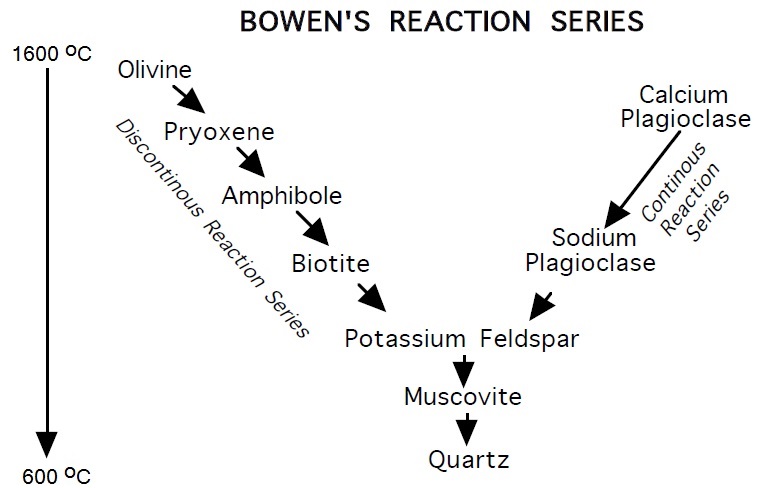
He found that the mineral formation followed a fairly simple and predictable set of pathways which can be represented in the following chart:
What does this chart tell us?
It says that as the temperature of a magma drops below 1600 oC Olivine crtstals will start to form in the magma. At a slightly cooler temperature, Calcium-rich Plagioclase crystals will start to form (CaAl2Si2O8). These two minerals are part of two separate chemical pathways and do not interact with each other chemically (they will interlock with each other as they grow larger). It is helpful to consider each of these two pathways separately.
The Discontinuous Pathway
Stage 1: Olivine begins to crystallize at it critical temperature. s the temperature drops, Olivine crystals will continue to grow.
Stage 2: Once a critical temperature is reached, Olivine is no longer a stable mineral. At this temperature, Pyroxene becomes more stable. If the magma contains enough silica (pyroxene is more silica-rich), two things will start to happen:
- pyroxene will start to crystallize out of the magma
- the olivine crystals will react with the magma to produce more pyroxene
If the magma cools slowly enough and if the olivine crystals remain in contact with the magma, then all of the olivine will convert to pyroxene. Otherwise, some olivine crystals will remain in the magma and form part of the resulting igneous rock. As the temperature drops, pyroxene crystals continue to grow.
Stage 3: Once a critical temperature is reached, pyroxene is no longer a stable mineral. At this temperature, hornblende becomes more stable. If the magma contains enough silica (hornblende is more silica-rich), two things will start to happen:
- hornblende will start to crystallize out of the magma
- the pyroxene crystals will react with the magma to produce more hornblende
If the magma cools slowly enough and if the pyroxene crystals remain in contact with the magma, then all of the pyroxene will convert to hornblende. Otherwise, some pyroxene crystals will remain in the magma and form part of the resulting igneous rock. As the temperature drops, hornblende crystals continue to grow.
Stage 4: Once a critical temperature is reached, if the magma contains enough silica, biotite begins to crystallize out of the magma and given the same conditions are met as before, the hornblende starts to convert to biotite. As the temperature drops, biotite crystals continue to grow.
Stage 5: At a critical temperature, if the magma contains enough silica, orthoclase feldspar begins to grow and, given the same conditions are met as before, the hornblende and biotite start to convert to feldspar. As the temperature drops, orthoclase fledspar crystals continue to grow.
This reaction pathway is called a discontinuous series since there are large ranges of temperature where one mineral is stable and grows preferentially over the others.
The Continuous Pathway
This pathway is similar to the discontinuous one in that a given mineral, Calcium-rich plagioclase (CaAl2Si2O8)), starts crystallizing at a high temperature and is replaced, as the temperature drops, with another (Sodium-rich plagioclase - NaAlSi3O8). The two plagioclase mineral classes can exist in solution with each other. In this reaction pathway, the process of replacement of one mineral with another is gradual and continuous. As the temperature drops, the crystal lattice becomes more sodium rich and less calcium rich until the mineral lattice has the same proportions of Na to Ca as the original magma. If the crystallization process is slow enough, plagioclase crystals will alter throughout. If the process is too rapid, crystals will be concentrically zoned: Ca-rich on the inside and Na-rich on the outside.
Residual Pathway
As both of these reaction series continue, the magma becomes progressively enriched in silica, sodium, and potassium. Once the temperature is low enough, this magma begins to crystallize out orthoclase fledspar, muscovite mica, and finally quartz. This last mineral is left to fill in any remaining void spaces in the rock.
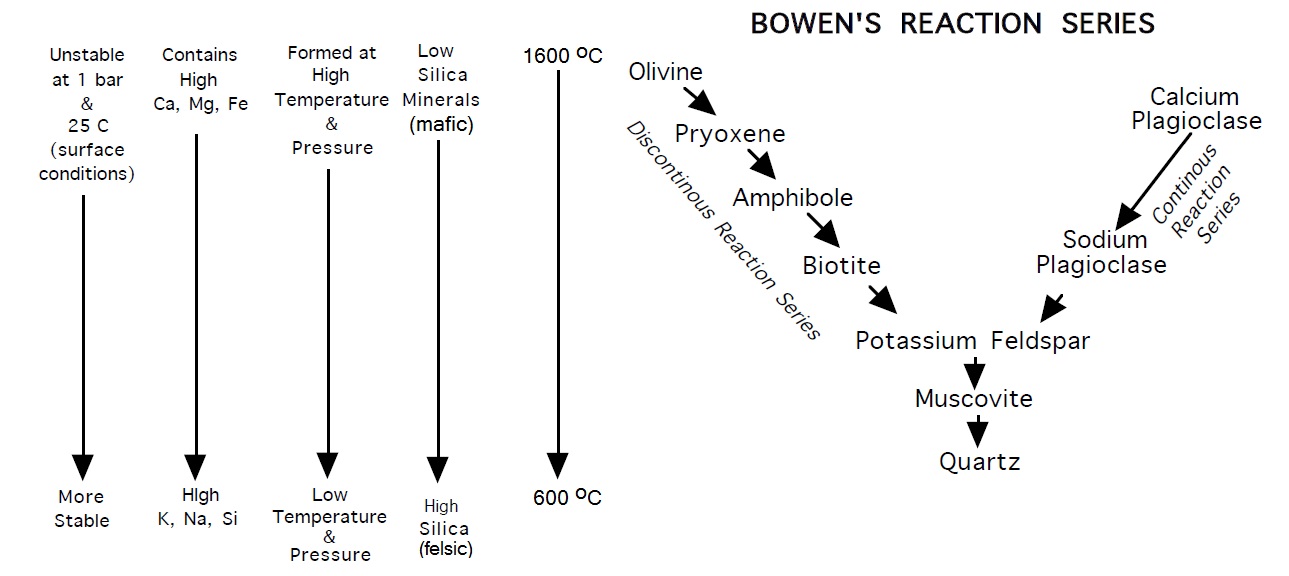
Summary
Melting
It is important to note that Bowen's Reaction Series also works in reverse. As a rock mass is heated up, the first minerals to melt are the ones at the base of the reaction series diagram. As temperatures rise, minerals higher on the diagram also start to melt. This has important implications for the for the composition of a magma from the melting a pre-existing rock. If a rock is only partially melted, then only the minerals at the Felsic end of the reaction series will melt. The resulting magma will be more Felsic than the original rock.
Solidification
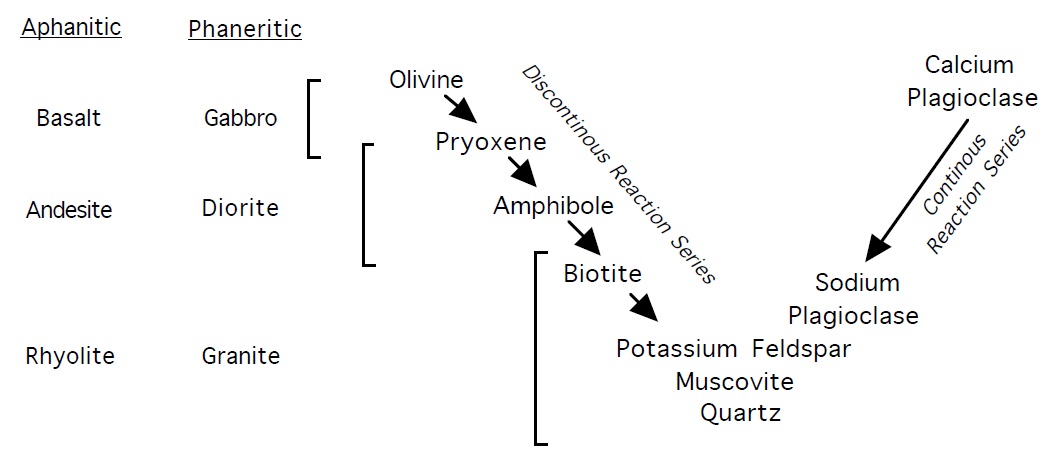
How far the magma progresses to the bottom of the reaction series depends on how much time the magma spends at each stage of the series and what the starting composition of the magma is (Silica content, metal cation content). Only a silica rich (felsic) magma can progress far enough down the reaction series to make K feldspar, muscovite, and quartz. Mafic magmas can only progress part of the way down the series. When the minerals crystallizing out have the same composition as the original magma, then the solids and magma are in equilibrium. If, however, the early crystal grains can separate themselves from the magma, the silica content of the remaining magma can be increased. How much magma is available for the formation of each of the rock types in the last diagram (gabbro, diorite, granite), depends on the composition of the original magma. What finally forms and where depends also on what happens to mineral grains as they form early in the process and if they stay in contact with the magma, and what pre-existing rocks the magma has to interact with. A mafic magma can differentiate into something much more felsic as the first crystals separate themselves form the liquid phase, but the amount of felsic magma left over usually is less than 10% of the original magma volume.
The process of altering a magma as it undergoes crystallization is called magmatic evolution.
The evolutionary process includes differentiation of the magma as mineral grains form and separate from the magma, either because the solid crystals settle out or the magma's liquid component is squeezed away from the solid residue. It also includes the process of assimilation of material from the rock surrounding the magma chamber, which may be quite different from the chemical composition of the magma.
These processes have a significant bearing on a major question in geology: how did the continents get to be so different from the oceanic crust and mantle if the mantle is the ultimate source of material from which the crust formed? We will tackle these issues in our next class.
Evolution of Magmas and production of Volcanic Rocks
1) All magmas form in the upper-most 200 km of the crust and upper mantle.
They are not a result of plumes of molten material bubbling up from deep in the mantle.
2) If a magma cools until all of it is solidified and all of the crystals, as they form, remain in contact with the magma, then the final rock will have the same composition as the magma.
3) If solid crystals and remaining magma become separated, if the rock from which a magma only partially melts, or if the magma interacts with the rock material surrounding the magma chamber, then the rock formed by the magma will not be the same as the rock from which the magma was made. This is called Magmatic Differentiation
Simplest Case: No Differentiation
A rock made of 50% pyroxene and 50% plagioclase (a) is melted completely (b).
If then cools in place in a magma chamber. The first mineral to crystalize out will be Olivine (c) followed by calcium plagioclase. These two minerals have a lower silica content than the original magma, so the silica content of the magma will increase. This is because olivine has two Mg2+ ions per silica tetrahedron and the pyroxene of the original rock has just one. So, the more olivine that crystallises out of this magma, the more silica is left behind in the magma relative to the number of Mg ions present.
Once the temperature drops low enough, pyroxene and more sodium-rich plagioclase will start to crystalize (d). If the earlier crystals are sill in contact with the magma, they will react with the magma and form into pyroxene and more sodium-rich plagioclase as well(d). This will use up excess silica in the magma and the magma will become more mafic again (d). Once this process is complete, you will have a magma and a set of growing crystals that have the same chemical composition as the original rock (e). At this point, even if the temperature was to suddenly drop below that at which amphiboles would start to crystalize, no amphiboles or anything else lower on the Bowen's Series can form since there is no extra silica on hand to make these silica-rich minerals (to do so would leave a magma with a lot of extra positive metal ions hanging around). So, the most felsic sort of mineral assemblage we can end up with is the one that originally melted.

Less Simple Case: Fractional Crystalization
We take the same rock as before (a) and completely melt it (b). Olivine and Ca-plagioclase start to crystalize out and the magma gets more silica-rich (c). This time, these crystals settle out as a solid layer at the bottom of the magma chamber and can no longer interact with the magma (d). The more that this occurs, the more enriched in silica the magma gets. When the magma cools down enough to crystallize pyroxene, there is more silica present in the magma relative to metal ions than is found in pyroxene, so the pyroxene crystallization continues to make the magma more and more silica rich (e). This time, when the temperature gets low enough to crystallize amphiboles, there is lots of extra silica on hand in the magma to do this and start to convert some of the pyroxene as well (f).
If this magma finishes solidifying underground, it will have two layers: one that is more mafic than the original rock on the bottom and more felsic than the original rock at the top.
If the magma is erupted onto the surface after pyroxene crystallization has started and the lava will be closer to an andesite rather than the basalt that would have formed from the undifferentiated magma in the first example.

How do Magmas Form?
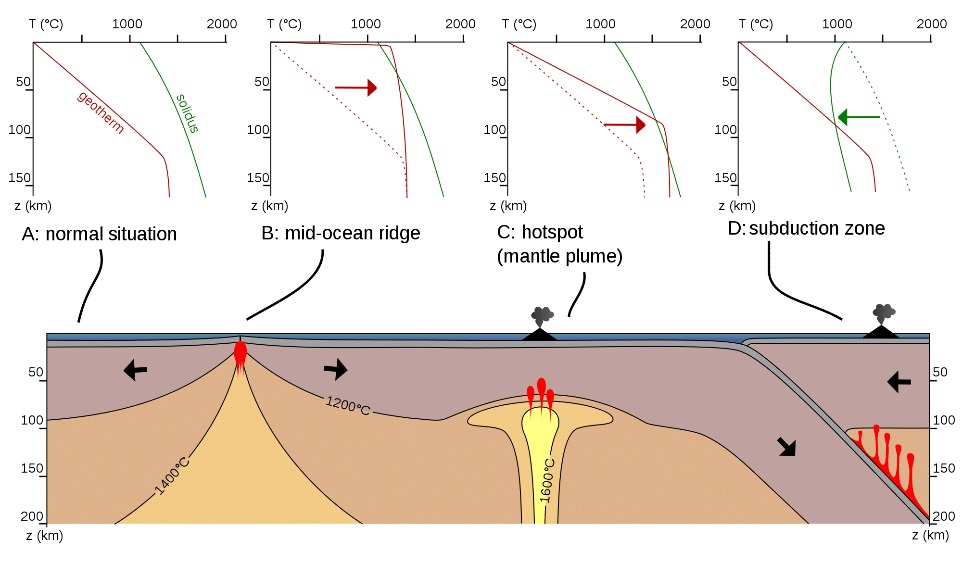
Normally, the thermal and pressure gradients in the earth are such that minerals are generally below their melting point all the way down to the outer core (Situation A below). At the Asthenosphere (about 250 km depth) the temperature and melting point get close to each other, but not much actual melting takes place. For the most part, the material in this layer is just very soft and easily deformed under stress. Large-scale melting of rock requires special conditions.
There are three basic ways to cause rocks to melt:
1) Thermal Energy Transfer. The temperature at the base of the lithosphere is increased by activity in the Mantle. This is what seems to occur at "hot spots," which are thought to be plumes of warmer material that slowly circulates upward and then sideways along the base of the lithosphere. This is much like the density-driven convection cells that form in water being heated over a stove, but more slowly and without actually being liquid. Where this mantle plume hits the lithosphere, the thermal energy can be conducted upward enough to push the temperature at the base of the lithosphere above the melting point. The less dense liquid magma can then move upward (Situation C below).
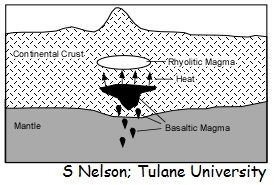
This also can happen in situation D, when magma moving upward heats up and melts lower melting point minerals in the rocks above it. This is one way in which felsic magmas are formed.
2) Decompression Melting (Situation B below). At places where tectonic plates are spreading away from each other, the crust is quite thin and the warm mantle material is much closer to the earth's surface. Because of this, it is under much less pressure and so its melting temperature is much lower; low enough to melt at least some of the minerals (the "solidus" green line represents the melting temperature and shows how it increases with greater pressure at depth).
3) Flux Melting (Situation D below). As subduction of lithospheric plates carries them down into the mantle two things cause significant melting to occur.
a) Chemical weathering of rock at the earth's surface can cause the mineral assemblage in the rock to become more felsic. Unstable olivine and pyroxene are converted to clays and micas as their metal ions are converted to oxides or dissolved away. These minerals have a lower melting point and will melt off of the descending plate and rise back to the surface.
b) The descending plate contains a great deal of water mixed in with the rock and sediment. The presence of this water causes the melting temperature of the rock minerals to be reduced as pressure increases. This causes more melting of material off of the descending plate than would occur otherwise. However, it is the more felsic minerals which melt. The more mafic minerals, which are more like the surrounding mantle material, have a higher melting point and may not melt.
CO2 also can lower the rock melting point. Where would this gas come from? Consider what sort of biological precipitation of sedimentary rock naturally occurs in the oceans.
Continental Crust Formation
Partial Melting results in the formation of more felsic magmas, which ultimately accumulate at the surface due to their lower density. This is the source of the low density rock of continental crust. Its formation and build-up would have occurred over billions of years during the early part of Earth's history as plate tectonics cycled rock material up into oceanic crust and back down into the mantle, each cycle removing the more felsic parts of the descending tectonic plates.
Mechanisms for Magma Formation
Additional Reading
A) Formation of
Igneous Rocks
B) USGS Volcanoes
Questions
1) What sort of magma will be produced by each of these situations in terms of...
- a) composition?
- b) temperature?
- c) viscosity?
- d) dissolved gas content?
2) What style of volcanic eruption will occur at each of these sites?
3) What type of volcano will characterise each of these sites?
4) Which intrusve and extrusive igneous rocks would you expect at each of these sites?
5) How might the ignesous rocks produced by situation D differ if the descending slab is under another slab of oceanic crust as opposed to a slab of continental crust?
6) From where does the magma for basalts and gabbros come?
7) How is the magma that makes diorite and andesite formed and where does this take place (geological environment)?
8) How long does the cooling process for the formation of granite take?
9) What are the three types of volcanoes?
10) What compositional type of magma is involved in each type of volcano (mafic or felsic)?
Additional Resources
How Volcanoes Work