IGNEOUS ROCKS
Rocks and Minerals
Just to review: minerals are chemical compounds which are naturally occurring, crystalline, solids at normal temperatures on the earth's surface. Rocks are mixtures of different minerals in the solid state. Rocks differ in both the types of minerals present, the size of the mineral crystals, and how the different minerals are distributed through the rock.
Igneous Rocks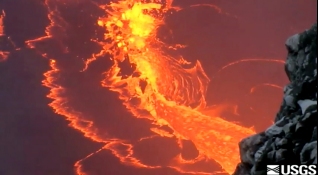
Igneous rocks (from the Greek word for fire) form when hot, molten rock (magma) crystallizes and solidifies.
The magma (often called the "melt") originates at a limited number of situations within the upper-most few hundred kilometres of the mantle: near active convergent or divergent plate boundaries or at hot spots (which may result from mantle plumes). It then rises toward the surface where it either erupts onto the surface or solidifies in place within the crust or upper mantle. Thus, igneous rocks are divided into two groups:
Intrusive Rocks
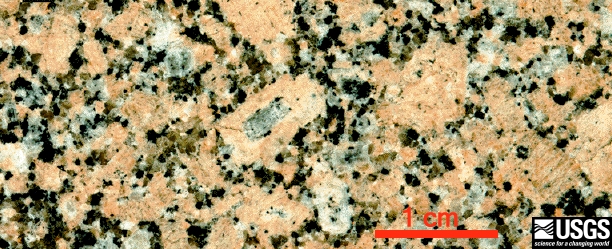
These rocks form from magmas which cool and solidify slowly at the depth, often over thousands to millions of years, depending on the size of the magma body. Rock is a poor thermal conductor, so large magma bodies can retain their thermal energy for long periods of time if they are deep within the crust. This results in rock textures consisting of large, interlocking crystals. The slower the cooling process, the more time the crystals have to grow to a larger size.
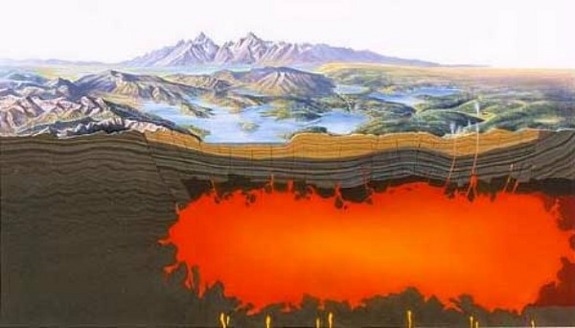
Magma can be found in large magma chambers (A), usually kilometres below the surface. From these, it can move upward into smaller spaces: dikes (B), sills (E), laccoliths (C), and other smaller bodies (D). These chambers also can feed volcanoes and other eruptive sources that produce fine-grained extrusive rocks (F).
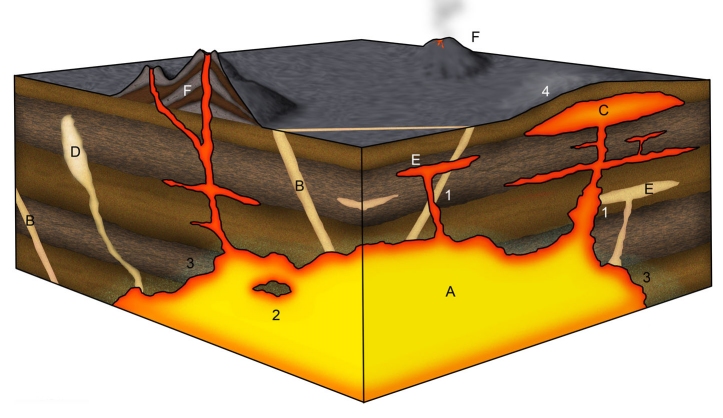
The material in magma chambers is not normally entierly liquid. It usually is in a more spongy state, perhaps cottage cheese is a better analogy. As little as 10% of the material might be in a true liquid state. However, if magma starts to leave the chamber upward, this can reduce pressure in the chamber and initial further melting.
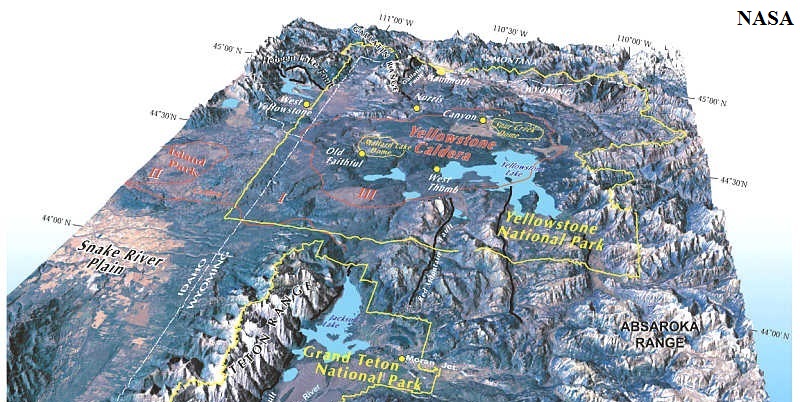
Magma chambers can be quite large. The upper chamber under Yellowstone National Park in the United States is almost 10,000 km3. A newly discovered chamber below this one is thought to be over 4 times bigger. As the pressure in these chambers changes, the ground surface can be observed to rise and fall by many centimetres.
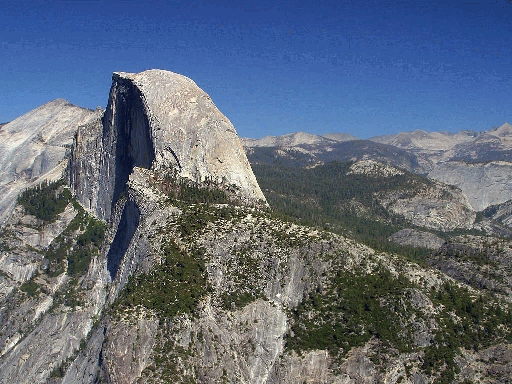
The size of these chambers can be appreciated when, after cooling and solidifying, the resultant rock masses (called Plutons or Batholiths) are uplifted and exhumed by erosion of the surrounding rock. The Sierra Nevada mountains are an example of this. Half Dome (see below) is a 500 m tall cliff of granite-like rock. This represents a very large mass of solidified magma, but what is less obvious is that all of the other mountains in the forground and background are part of the same complex of batholiths.
Extrusive Rocks
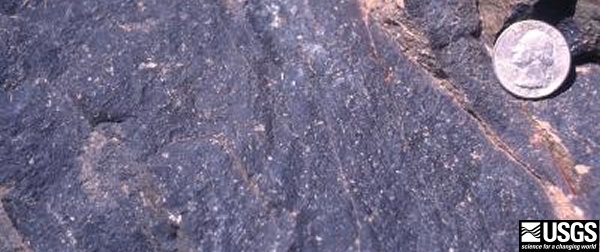
These are rocks which form from lava: magma that erupts onto the surface and cools too rapidly to form large crystals. Ordinarily, the rocks do not show any visible crystals at all.
The character of the lava that erupts at the surface produces differences in the resultant rock as well as the size and shape of volcanoes. These differences include:
- mineral make-up; particularly the amount of silica in the lava
- the temperature of the lava
- the amount of dissolved gases in the lava (particularly water, carbon dioxide, and other non-metal oxides)
Most lavas fall into two broad categories:
- less hot, gas-rich and silica-rich lava
- hotter, silica-poor, and gas-poor lava
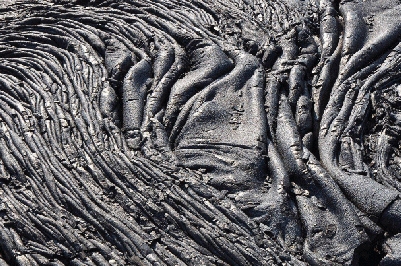
Silica-poor lavas are more similar to the composition of the upper mantle. These lavas are generally less explosive and less viscous. The often flow along the surface for long distances and make low-profile volcanoes (more on this later). The appearance of this sort of lava after it has cooled and solidified is one of a smooth, folded fabric. This type of volcanic rock is called Pahoehoe (pronounced "Pah-hoi-hoi").
Hawaiian volcanoes Video
Volcanoes in Hawaii mostly produce this sort of lava.
While watching this video, note how runny the lava is. There are some gas-rich pockets that produce more explosive eruptions. Some of these are probably caused by gases being produced by heating of the material that the lava is running over. These lavas are typical of divergent plate boundaries (spreading centres) and mantle hot spots.
Silica-rich lavas
These lavas are made more viscous by the development of complex silica molecules as the lava cools. They also typically pick up large amounts of dissolved gases when they are melted, particularly water. This gas stays dissolved in the magma while under pressure, but, likeCO2 in soft drinks when the bottle cap is removed, this gas bubbles out of solution and causes the magma to be ejected from the earth in a much more explosive manner.
The greater viscosity and lower temperature of this magma, coupled with the smaller fragments it forms in flight, cause it to form semi-solid pieces when it falls to earth rather than flowing away. This results in a much less smooth rock surface. This type of volcanic rock is refered to as Aa (pronounced "Ah-Ah").
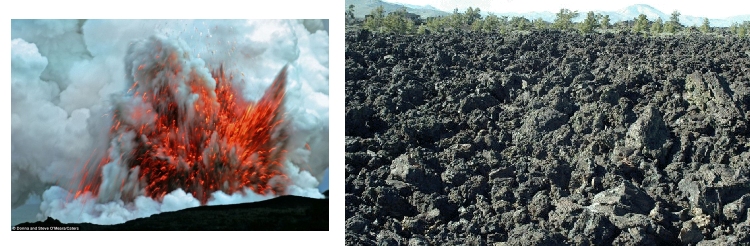
Mount Etna explosive eruption video
Note that:
- much of the material is ejected as ash
- the lava fragments accumulate as irregularly shaped fragments on the ground rather than flowing away from their source
- the material that the people are standing on looks like the aa lava in the picture above
Ash is a common product of this lava and is formed when the froth of viscous magma is blown apart by the gas pressure into tiny fragments which solidify into shards of glass and are carried up into the air by the ascending hot gas.
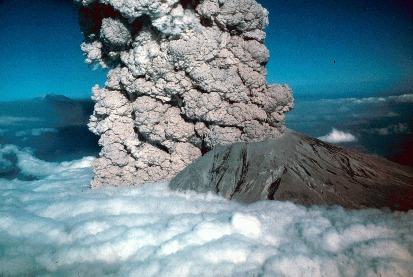
Unlike the soft ash produced in a campfire, volcanic as particles are sharp, hard, and very damaging if inhaled. They are much like the fragments of aa lava, but on a smaller scale.
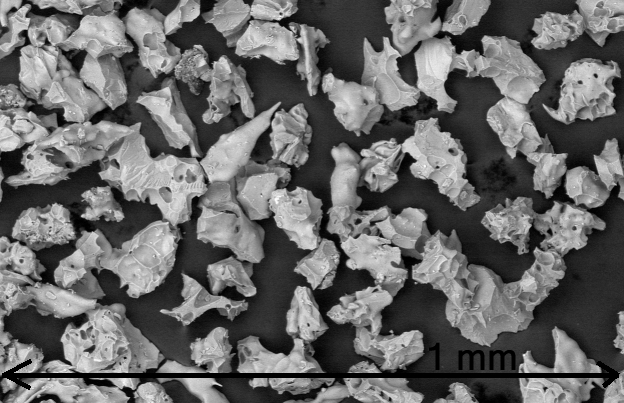
If the density of the ash cloud is great enough, the cloud becomes too dense to rise and falls down the mountain side as a pyroclastic flow. These flowing clouds of ash can move at speeds exceeding 200 km/hr and have internal temperatures over 800 oC. They are extremely hazardous and destructive.
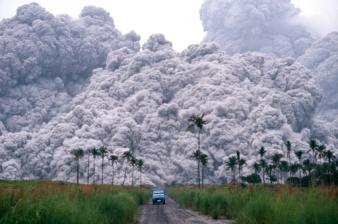
Pyroclastic Flow videos
Ash can accumulate in great thicknesses, as in this photo of the ash beds in front of Mount Saint Helens. This is 35 years after the eruption that produced them. Streams are starting to cut into the soft ash and this allows us to appreciate the thickness of these deposits. The pine trees growing on the ash give a sense of scale. They are at least 3 m tall.
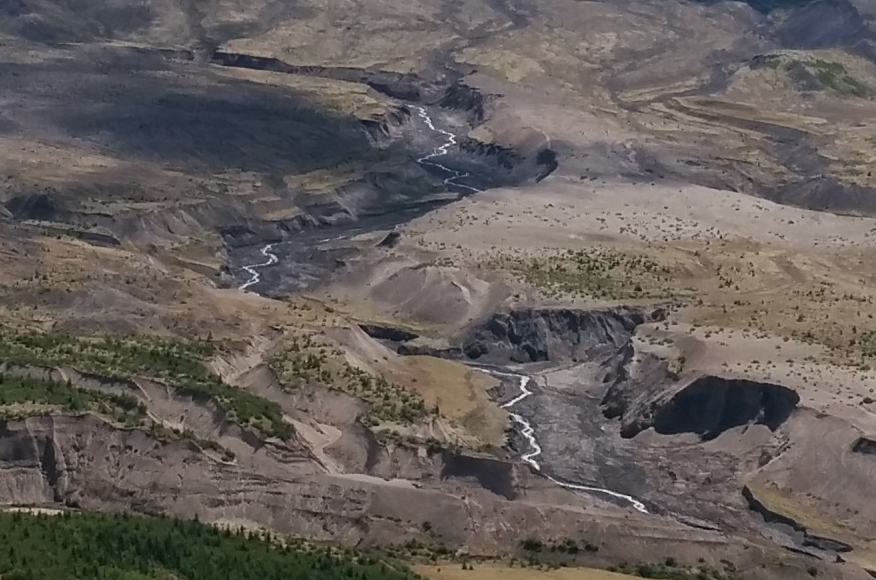
This ash can cause problems down stream as it redeposits and contaminates agricultural land and built-up areas. In the worst case, heavy rains can mobilise the ash as a Lahar, a fast-flowing river of suspended ash much like cement in its density. These can cause extensive damage to building, roads, and bridges.
Lahar flows videos.
Erupted Material Volume
Volcanic eruptive events are unlikely to release all of the material in the magma chamber.
That said, some volcanic events can be very large. Even comparitively small eruptions can be devastating and wide-ranging in their effects. That eruption released less than half a cubic kilometre of magma, mostly as ash which occupies a lot more space. When one pictures that big a mass of material, it would still seem huge in our human scale of things. However, some recent and historic events have been orders of magnitude larger. The largest of the geologically recent yellowstone eruptions released more that 2000 km3 of magma as ash. That is enough to cover all of North America to a depth of 10 cm.
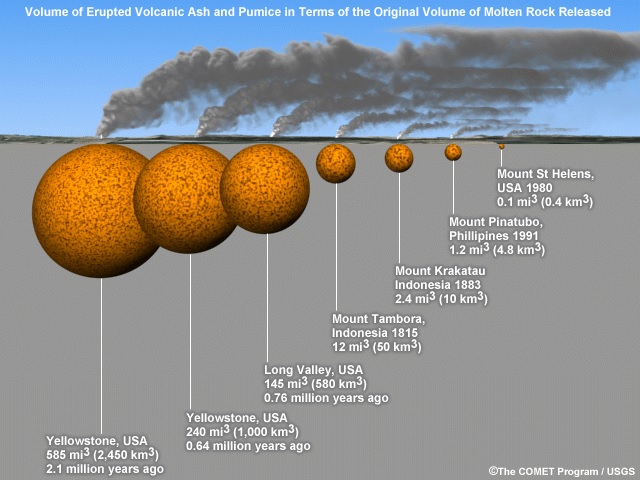
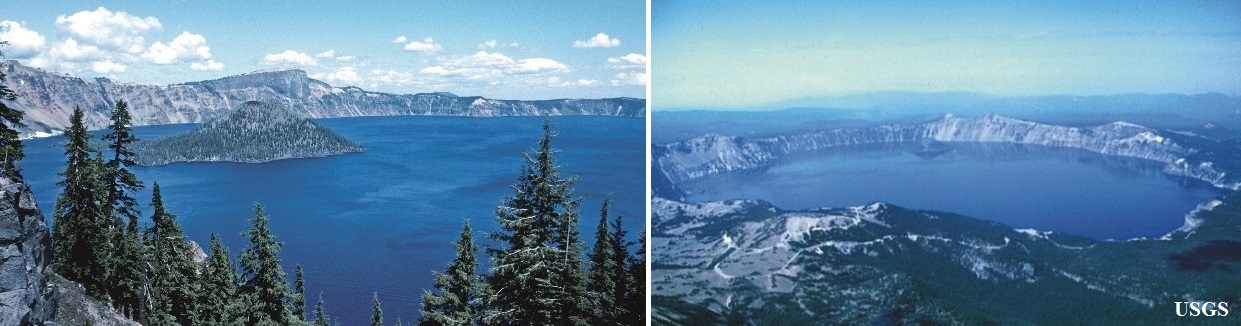
When large volumes of magma are released from a magma chamber. This often causes the ground above the magma chamber to collapse into the emptied space, creating a roughtly circular depression called a caldera. We will talk more about volcanic land forms later this next week, but for now the size of these calderas are a good way to appreciate the volume of material that was released.
One of the most scenic of these calderas is Crater Lake in Oregon (U.S.A): a 15 km diametre collapse feature that resulted from the eruption of about 50 km3 of magma at around 5600 BCE.
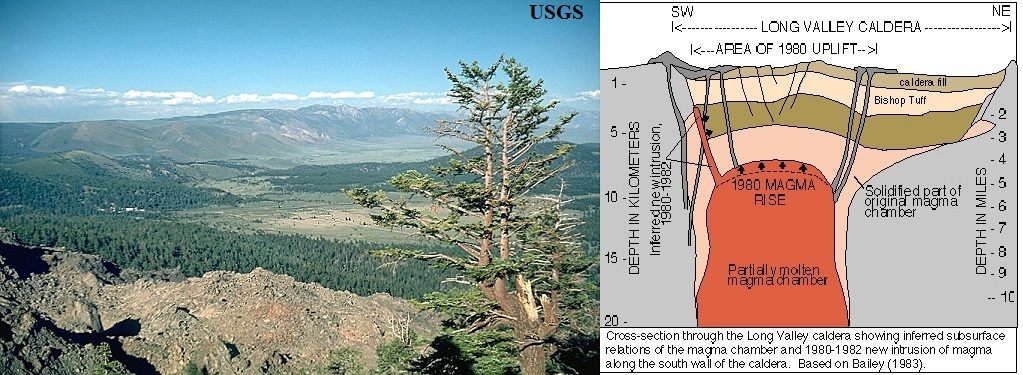
Further south in California is the 100 km diametre Long Valley Caldera. The uplifting of the dome near the centre of the caldera (seen behind the pine tree in the photo) demonstrates that the magma chamber under this caldera is still active.
The Yellowstone Caldera is even larger and also shows evidence (hot springs and vertical ground motion) of continued geological activity.