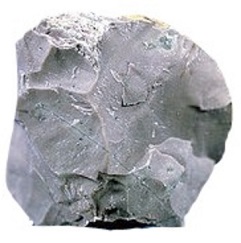
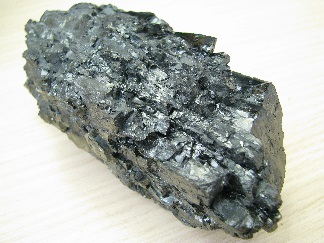
3) Micritic Lime Mud (Biological and chemical)
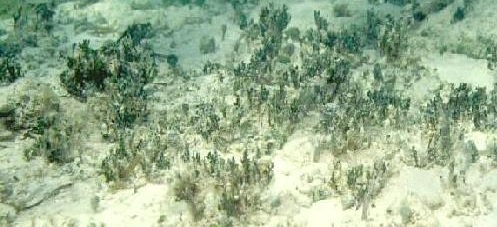 Micrite is a fine-grained mud that forms in shallow water from the disintegration of calcareous algae (algae that forms a calcium carbonate crust to protect it) as well as from direct preciptation from seawater. Micrite also can form from fecal material. Micrite often forms a part of the other classes of limestone mentioned here. Micrite is a fine-grained mud that forms in shallow water from the disintegration of calcareous algae (algae that forms a calcium carbonate crust to protect it) as well as from direct preciptation from seawater. Micrite also can form from fecal material. Micrite often forms a part of the other classes of limestone mentioned here. |
4) Ooid Sediment (Chemical)
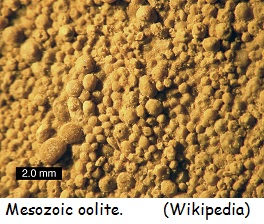 Ooids are small, sand-sized spheres of calcium carbonate that are seen to form in shallow, tropical marine (ocean) environments. They are thought to form as small particles of carbonate debris are rolled around on the sediment surface by wave action. They often display concentric layering, like a hail stone. Sticky coatings of algae and bacteria may play a role in the build-up of the calcium carbonate material. When they are cemented together, the sedimentary rock is called a oolite. Ooids are small, sand-sized spheres of calcium carbonate that are seen to form in shallow, tropical marine (ocean) environments. They are thought to form as small particles of carbonate debris are rolled around on the sediment surface by wave action. They often display concentric layering, like a hail stone. Sticky coatings of algae and bacteria may play a role in the build-up of the calcium carbonate material. When they are cemented together, the sedimentary rock is called a oolite. |
4) Travertine and Speleothems (Chemical)
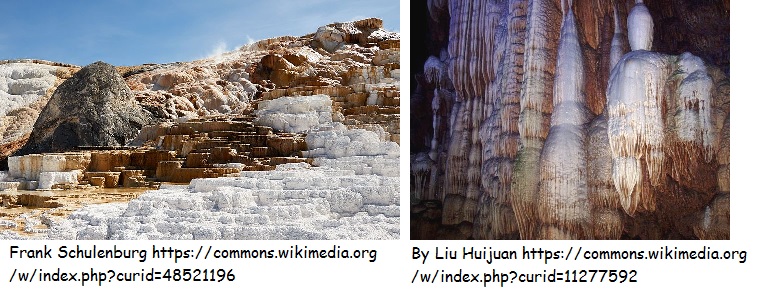 These forms of chemical precipitation of calcium carbonate occur when mineral rich water moving underground is exposed to the air releases dissolved carbon dioxide. This causes an decrease in the solubility of calcium carbonate (see above) which then precipitates out of solution. These forms of chemical precipitation of calcium carbonate occur when mineral rich water moving underground is exposed to the air releases dissolved carbon dioxide. This causes an decrease in the solubility of calcium carbonate (see above) which then precipitates out of solution.
|
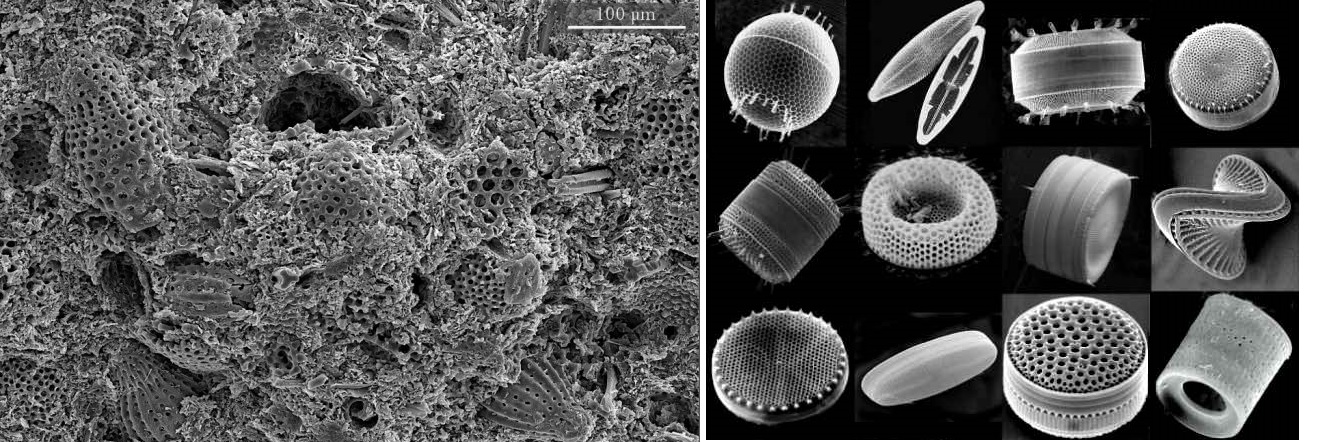 Diatomite is a sedimentary rock made from the compressed shells of diatoms (small algal cells). These shells fall to the ocean floor after the death of the cell and accumulate. This rock is prevalent in environments where calcium carbonate is not formed or accumulated. This material is especially valued for its utility as a filtering material for water purification and in the beverage industry.