Time
The PBS Spacetime Youtube channel described spacetime as follows:
Spacetime is what ever external reality underlies our collective experience of the space between things and the time between events.
Watch this, it is really cool:
 .
.
As a practical matter, I like to think of the space between two things as the number of standard objects (such as a metre stick) that can fit between them and the time between two events as the number of standard events (such as the click of the second hand of a clock) that happen between them. This does not explain much, but describes how we use the notions of space and time in most of our activities.
Systems of Time
There are several different formal measures of time.
Mean Solar Time (UT1) is just like it sounds: the time between one noon and the next. This is the 24 hour (86400 s) interval with which we are familiar; sort of. UT1 is a modern replacement to Greenwich Mean Time (GMT) and is based on celestial observations other than sun tracking as it is difficult to know when the sun is exactly above a given longitude (it is painfully bright, but more importantly, it is very large).
Co-ordinated Universal Time (UTC) is the time of the atomic clocks which tick out seconds with a precision such that they might be off by one second in 30 million years. They use the a number of vibrations of light emitted by a particular electron transition in Cesium atoms to define the length of a second. This is the definition of the metric system second.
Leap Seconds
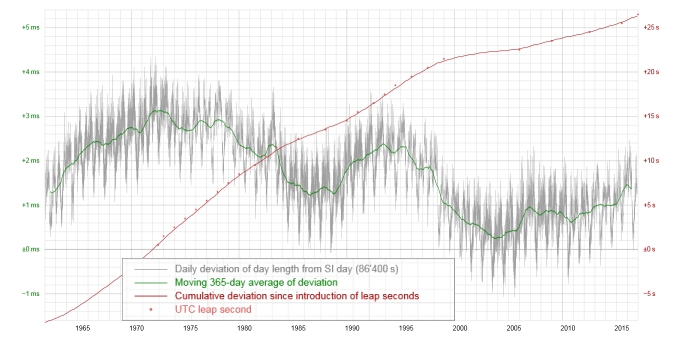
One little wrinkle in this way of looking at time is that the rotation rate of the earth, the process that creates our "day," is gradually slowing. A mean solar day is now 86400.002 seconds (s). This means that UT1 and UTC days will gradually get out of sync with each other. To keep them in sync, a leap second is added to the end of a day every few years (there have been nearly 40 of these since the practice was started). Some organizations manage these by adding a second to the last minute of the day, thus ending the day at 23:59:60 rather than 23:59:59. Other organizations, like Google, avoid the chaos that this would cause for their network by adding 1/86400 of a second to each second of the day, spreading out the leap second. Either way, leap seconds are scheduled far enough in advance to plan for them adequately. The implimentation of leap seconds is governed by the International Earth Rotation and Reference Systems Service (IERS). The goal of leap second implementation is to keep UT1 and UTC within 0.9 seconds of each other. However, there is a proposal under consideration to abandon this practice in favour of using leap hours to make the disruption of UT1 and UTC re-alignment must less frequent. Ultimately, some other solution will have to be adopted as the length of the UTC second and the length of the solar second get more different.
There are other independent time systems in use, such as GPS time, which could be used as a standard. There may come a day when we stop worrying about the synchronization of clock time and solar time (and abandon the idea of time zones, as well) and simply keep track of when noon, sunrise, etc. will be for a given day, if this continues to be of interest to us.
The Earth's rotation rate has been slowing at least as long as Earth has had a moon. We can track this over the last half-billion years by looking at fossil skeletons of animals, such as corals, that react to daily and annual changes in their environment. Their skeletons exhibit daily growth rings, much like the yearly rings in trees, and these daily rings also exhibit an annual variation in thickness due to the effects of seasons. This allows us to count the number of days per year back into the past. It would seem that 500 million years ago, there were over 420 days per year and that this number has been decreasing unsteadily ever since to our current value of just over 365. Examination of data collected over the last few centuries suggests that the Earth's rotation rate has been decreasing by the equivalent of between 1 and 2 ms per century. This is mostly due to tidal friction, and vertical movement of matter within the core and upper mantle and crust (glacial rebound and earthquakes, for example) which alter the earth's moment of inertia (think figure skaters altering their spin by moving their arms in or out). Short-term fluctuations in day length are mostly due to cycles in the alignment of the moon's orbit relative to earth's orbit around the sun. Daily variation in day length is discussed below.
Mean deviation between 86400 s and actual day length over a 50-year period:
.
Marking Time
We mark the passage of time by how the earth's rotation and revolution around the sun makes objects seem to move around on the sky.
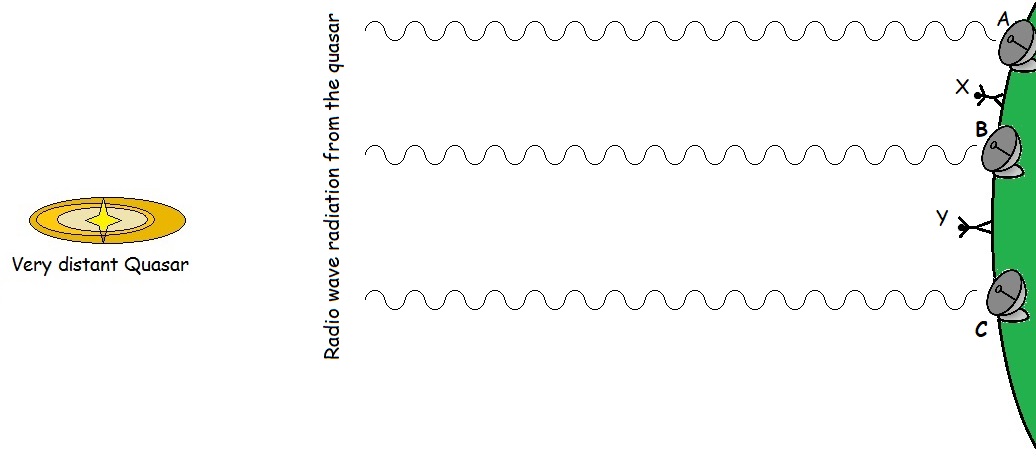
We can time the rotation and revolution of the earth quite precisely using a technique called Very Long Baseline Interferometry. Radio waves from distant active galaxies, quasars, are received by radio dishes scattered across the world (see diagram below). We can tell approximately what point on the earth is directly under a quasar by aiming the antenna dish, but not well enough to know if the earth's rotation rate is steady or not. Because quasars are so far away (more than trillions of times farther away than our own sun - we will talk about how we know that later) all the radiation from them arrives as nearly perfectly parallel waves. However, because the earth has a curved surface someone not directly under the quasar (person X) is slightly farther away from it than someone who is directly under it (person Y). If two radio antennas are the same distance from the quasar then the radio waves from the quasar are exactly in phase at the two antenna (B and C both see a wave crest at the same instant, whereas antenna A, slightly farther from the quasar, is seeing a wave trough at the same instant). If B and C are the same distance from the quasar, they must be the same distance from the point on the earth that is directly under the quasar (person Y). Therefore, person Y knows that they are directly under the quasar. Using an atomic clock, we can time exactly how long it takes until this happens again next day. This allows us to measure the precise number of milliseconds that it takes the earth to rotate 360o on its axis. Using this technique, we know that the Earth's rotation rate is not perfectly steady (neither is its revolution rate). The rotate period can vary by milliseconds in a day due to the effects of winds acting on the earth's surface as well as other factors such as redistribution of water, earthquakes, and changes to circulation within earth's core. These effects can produce variation in rotation rate over a wide range of time scales.
Time of Day
Our concepts of time are closely tied to how our planet is moving through space.
Time of day is nothing more than an indication of where we are on the Earth's surface (with respect to longitude) relative to what part of the earth is directly facing the sun. Time of year is nothing more than an indication of where the Earth is in its orbit around the sun. These concepts are only very loosely tied to the notion of the "passage of time" as discussed in the PBS Spacetime video, which I really hope that you have watched.
The Earth's orbit is slightly elliptical with the sun at one of the foci, though this is greatly exaggerated in the following image. As a result earth's distance to the sun changes throughout its orbit, though not enough to make much difference to its temperature. The cause of earth's seasons is addressed below.
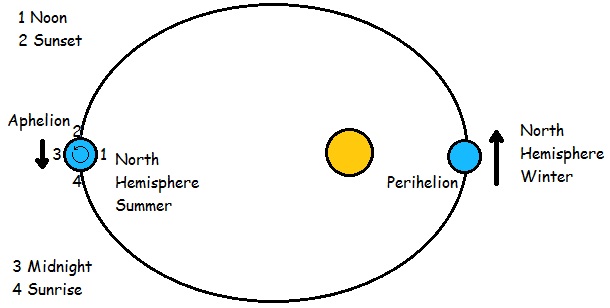
The difference in the point of closest approach to the sun (perihelion) and farthest distance (aphelion) are one way of marking the passage of a year. Like all orbiting bodies, the orbit speed is fastest at perihelion and slowest at aphelion, which we will find does complicate our understanding of what a day is.
The Day
There are two commonly used ways to define a day.
Sidereal Day
The sidereal day is the time taken for the earth to complete one 360o rotation on its axis. This can be measured with reference to distant stars (which is what the name signifies), which have no significant apparent motion across our sky.

The length of this day is approximately 23 hours, 56 minutes, and 6 seconds or 86,166 s.
Solar or Synodic Day
The solar day is the time that elapses from one noon until the next, keeping in mind that noon is just the moment when the sun is directly over the same longitude as you. This is not the same as the sidereal day because in the time it takes for the Earth to rotate once, it also moves sideways relative to the sun. Thus, after one 360o rotation from noon the previous day you will not yet be at noon, because your longitude will be pointing off to one side of the sun rather than directly at it. In order to bring us to noon, the Earth must rotate just a bit more. The term "synodic" refers to anything to do with how things line up in their orbits.
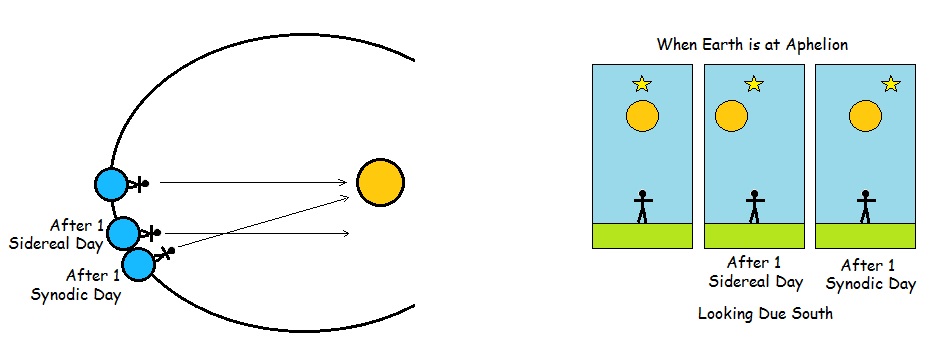
Mean Length of the Solar Day (UT1)
On average a solar day is 24 hours or 86400 s, but this is where the elliptical variation in the Earth's orbit speed complicates life for us.
The faster the Earth orbits, the further sideways it moves in one rotation, and the more extra rotation is needed to arrive at the next noon. This makes the day longer.
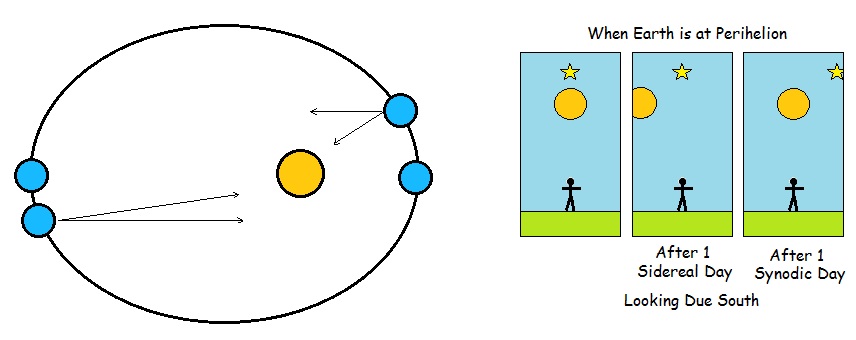
The Earth's sidereal rotation is roughly constant. Thus, since the Earth must rotate more from one noon to the next at perihelion than at aphelion, the length of a solar day is longer at perihelion than at aphelion. The difference is only a few seconds, but it does add up, as we will see.
Effect of Rotation Axis Tilt
As you know, the Earth's rotation axis is tilted by about 23o from the normal angle to the plane of Earth's orbit. This is why we have seasons as the incoming sunlight arrives at a shallower angle when our rotation pole is pointed away from the sun. This is why it can be summer in the southern hemisphere at the same time as it is winter in the northern hemisphere. It just so happens that at this moment in Earth's history the time of year when the northern hemisphere is tilted away from the sun coincides with Earth's perihelion. This changes over time, mostly as a result of the way in which our rotation axis wobbles.
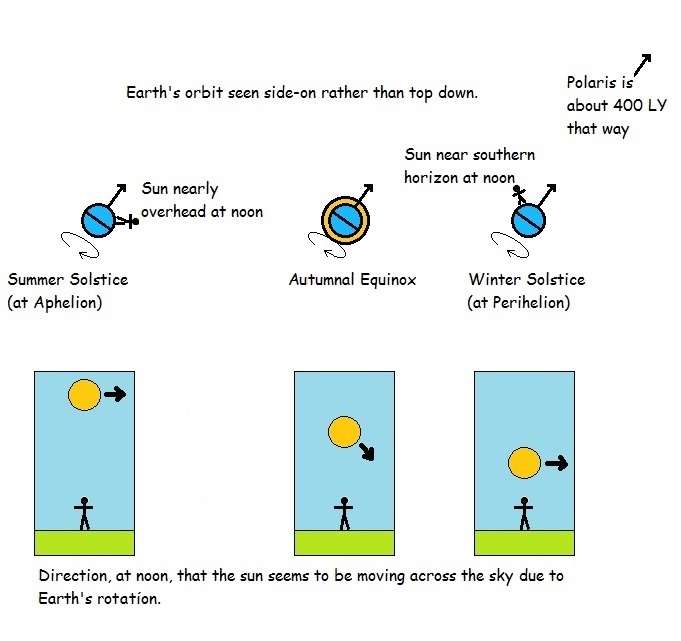
The tilt affects the length of a day because at the solstices the apparent motion of the sun across the sky (resulting from the Earth's orbit) is parallel to the equator. So the sun is a long way east in the sky after one sidereal day and the Earth must rotate quite a bit to bring you to the next noon. At the equinoxes, the equator is tilted relative to Earth's motion around the sun, so the sun appears to move at an angle to the equator. This means that the sun does not shift as much in an east-west sense over the course of a sidereal day and the Earth does not have to rotate as much past 360o to bring you to the next noon. Thus, the solar day is shorter. This effect on day length is slightly larger than the effect related to earth's elliptical orbit (perihelion vs aphelion).
These two effects add up to produce a variable day length as follows:
| Date (changes gradually)
|
Synodic day length (changes gradually)
|
| mid February
|
24 hrs
|
| late March (near the equinox)
|
23 hrs 59 min 42 sec
|
| mid May
|
24 hrs
|
| mid June (near the solstice)
|
24 hrs 13 sec
|
| late July
|
24 hrs
|
| mid September (near the equinox)
|
23 hrs 59 min 39 sec
|
| early November
|
24 hrs
|
| late December (near the solstice)
|
24 hrs 30 sec
|
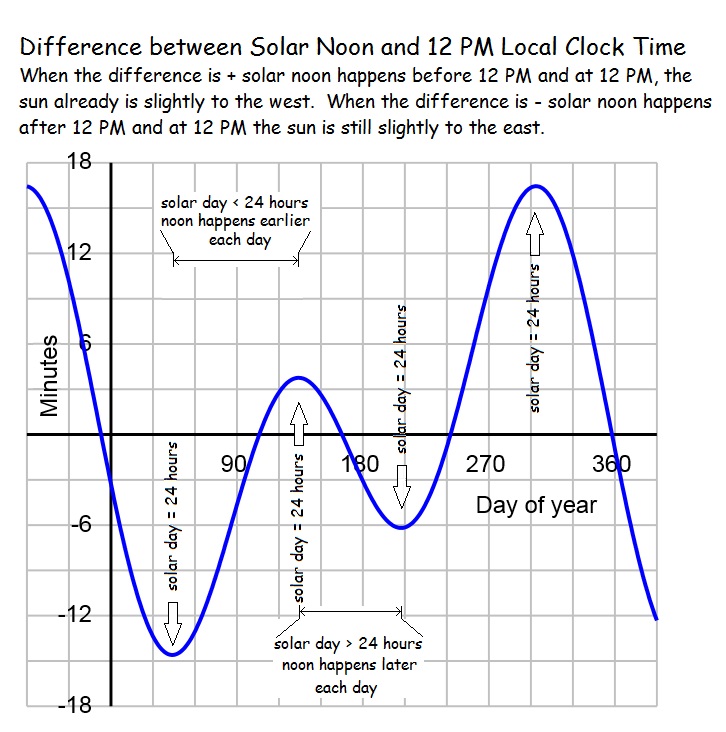
So, from mid February to mid May, the synodic (solar) day is shorter than the UT1 clock day. In other words, there are fewer seconds between one solar noon and the next compared to the fixed 86400 s between 12 PM on one day to 12 PM on the next (clock time). Thus, the sun gets progressively farther ahead of clock time each day. Solar noon will occur earlier and earlier by the clock each day because the small difference between UT1 day length and solar day length adds up each day. From mid May to late July the synodic day is longer than the clock day and solar noon will occur later and later each day relative to the UT1. From late July to mid February a similar, but more extreme cycle is observed.
UT1 is set up such that at the winter solstice solar noon and UT1 noon coincide. Since, at that period of the year, the solar days are longer (it takes more seconds to go from one solar noon to the next) than the clock days, solar noon gets farther and farther behind clock noon. So if you go out at 12 PM and look south, the sun will not quite have reached its high point and will still be slightly to the east. This discrepancy gets larger and larger until mid February when the solar days start getting shorter than clock days. The synchronization pattern for solar and clock noon over the course of the year look like this:
Solar Analemma
If you were to go out at 12 PM every day for a year and look up to the south and mark the position of the sun in the sky then the path of the sun over the course of the year would trace out a shape called an analemma. The vertical component of this path results from the tilt of earth's rotation axis: the sun is highest in the sky for the northern hemisphere in June and lowest in December. The side-to-side component is a result of the sun going in and out of sync with UT1 time as described in the graph above. So, just like the graph suggests, in mid February, solar time is behind UT1 time, and when you look south at 12 PM, the sun is still to the east.
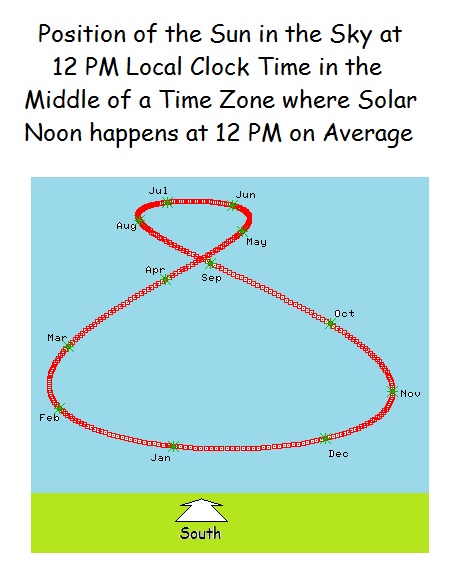
If you were to perform your sun position tracking at dawn or sunset, you would see the same analemma, but it would be tilted towards its side. It is for this reason that the latest sunrise and earliest sunset do not happen on the winter solstice, the shortest period of daylight of the year (though the longest day for us northern hemisphereans). Since the analemma is tilted, the lowest point of the analemma to the horizon at sunrise is the position for early January. The lowest point of the analemma to the horizon when it is tilted the opposite way at sunset is the position for early December, so that this is when the earliest sunset occurs. The amount of tilt varies with latitude. My analemmas are a bit exaggerated in their width and I think that this is making the actual dates on earliest sunrise and sunset on the diagrams below inaccurate.
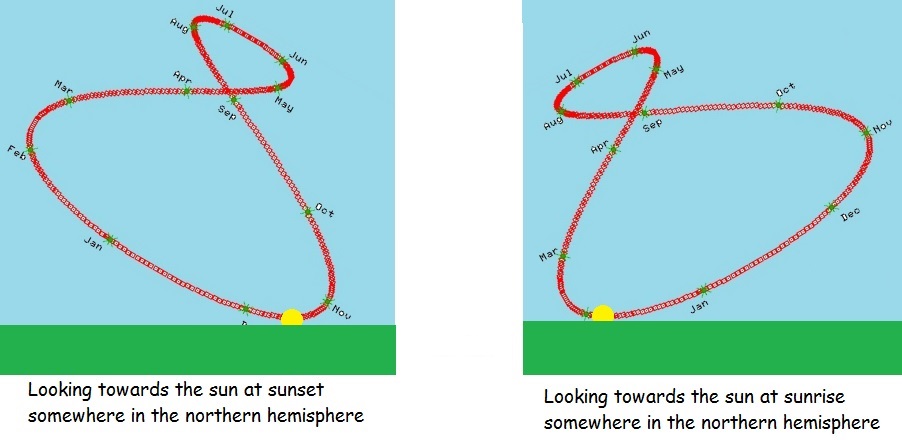
The reason that these two analemmas are only tilted by 45o is that they are drawn as we would see them at a latitude like ours which is 45o north of the equator.
The Year
Sidereal Year
This is the period of one 360o revolution around the sun and can me measured with reference to distant objects like stars and quasars.
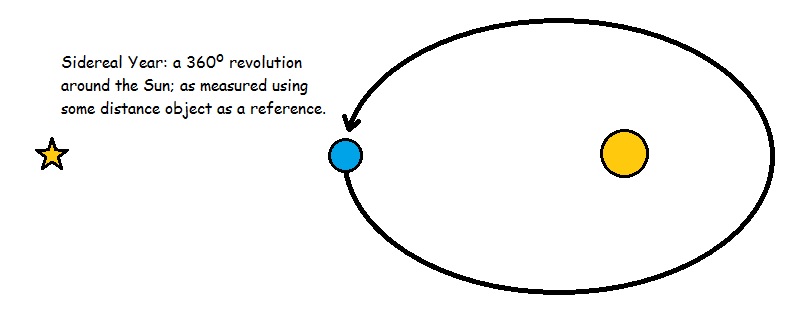
The duration of this year is approximately 365.256 mean solar days. This is not the year that we use for our calendar.
Anomalistic Year
This is the period if time taken to revolve from one perihelion to the next. It can be applied without any references to objects outside the solar system.
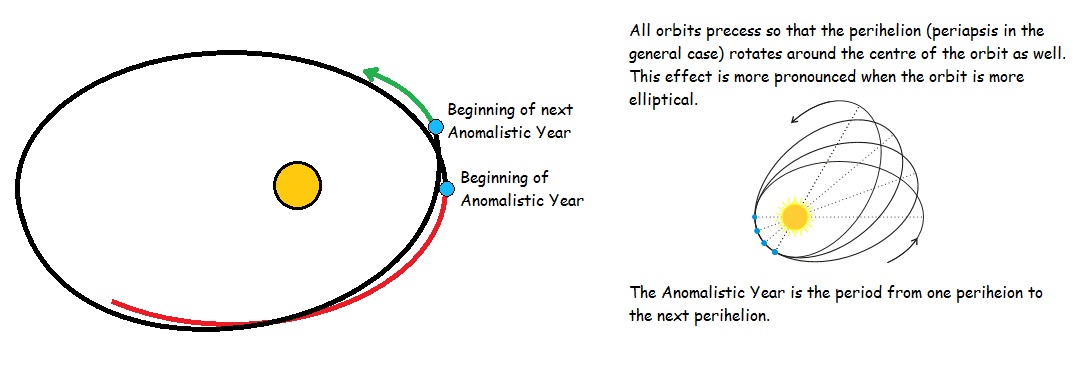
Because the perhelion precesses in the direction of Earth's orbit, the duration of this year is longer than the sidereal year: approximately 365.260 mean solar days. This also is not the year that we use in our calendars.
Tropical Year
This is our calendar year as it is defined with reference to Earth's seasons. It is the period of time between one spring equinox and the next. The spring equinox is defined as the moment at which the point on the Earth's surface that is directly below the sun goes from being south of the equator to being on the equator.
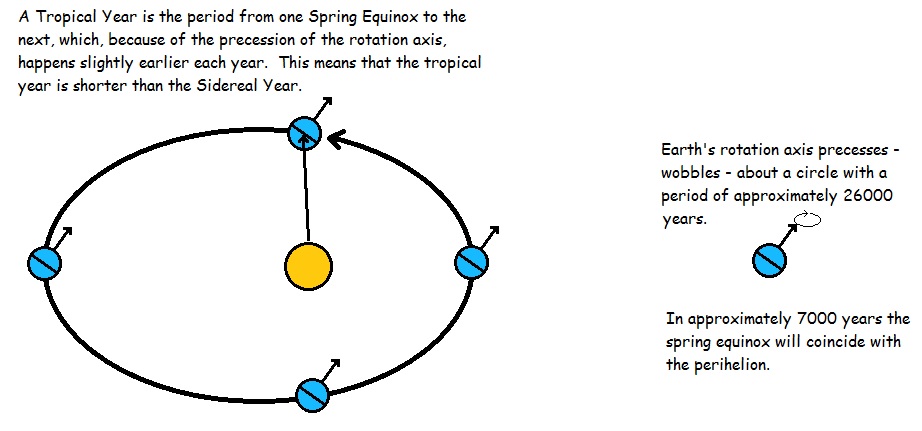
The duration of this year is shorter than the sidereal year, 365.242 mean solar days, because of the wobble of Earth's rotation axis. This gradual reorientation of the Earth's spin axis over time means that the spring equinox occurs not quite a full 360o revolution around the sun each year.
Days per Year
Given that a year is 365.242, one might make the might make the mistake of thinking that it has that many sidereal rotations in a year. If you do the math, though, you will see that it goes through just over 366 rotations during a year (365.242 solar days per year X 86400 s per day / 86166 s per sidereal day).
Imagine a planet that has a sidereal rotation that lasts one quarter of its sidereal year (4 rotations of 360o per year). Both its revolution around its sun and it rotation on its axis are counter-clockwise. How many solar days would experience per year? The easiest way to see the answer is with a diagram.
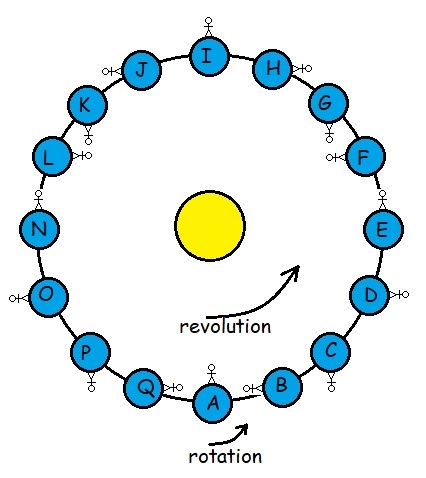
Starting in position A at the start of a year, the chart shows 16 positions through the course of a sidereal year. There are four rotations in that year: positions A to E, E to I, I to N, and N back to A. The little stick figure stays in the same spot on the planet the whole time. When the planet is at position A in its orbit, the stick figure is at noon (the sun is directly overhead). As the planet orbits and rotates the stick figure does not experience noon until after position F. Consider that the Sun would be above and to the left in the sky at time F and above and to the right at time G. Therefore, it must be directly above at some time between F and G. The next noon does not happen until between K and L. The next noon after that does not happen until the planet is back to position A. So one year has 4 sidereal days, but only 3 solar days.
Try for yourself to work out how many solar days should occur if this same planet rotates clockwise instead (but still at 4 sidereal rotations per year and still orbits counter-clockwise). You should find that at year will have 5 solar days.
Moving around on the earth also changes the number of days that you experience. Since the Earth rotates from west to east, one could walk westward at the same speed at earth's rotation speed at your latitude and keep the sun directly overhead: perpetual noon. If you are on the equator this would require a walking speed of 1668 km/h. Not so easy. Close enough to the south or north geographic pole (a few kilometres) this would be feasible, however.
Even a slow journey around the earth - a circumnavigation - can affect the number of days one experiences. My understanding is that this first was predicted by Abu'l-Fida, a 13th century Syrian geographer (among other occupations). The effect was first observed on the completion of the Magellan-Elcano circumnavigation of the Earth by ship in 1522. Accurate accounting by the crew gave the date of return as July 9th whereas the date by the accounting of people who had not been on the voyage was July 10th. The crew had experienced the passage of the same number of seconds as everyone else, but had seen one less sunrise as they had been sailing in the same direction as the apparent motion of the Sun in the sky (westward). Today we manage this issue by use of an international date line that runs roughly north/south through the middle of the Pacific. It is much like any other boundary between time zones, except that crossing from east to west one moves ahead 23 hours instead of back 1.
Calendars
The Julian Calendar
This was instituted by Julius Caesar in 45 BCE. It was defined as 365.25 days long (mean solar days we would call them now). To avoid having a quarter of a day at the end of each year, the quarter day was saved up and added as a whole day to the calendar every four years (a leap year).
This is still the official year length used in astronomy for purposes of calculating things like the Light Year.
The Gregorian Calendar
The Julian year came close to the length of a tropical year, but went out of sync by one day every 128 years. Since years were marked by the seasons just like our tropical year of today, the calendar date of significant events like the first day of spring kept changing. This annoyed people, especially the catholic church who wanted the Easter holiday to happen at a certain time in spring like the event that it was supposed to celebrate. Thus, Pope Gregory XIII published a revised definition of a year to be 365.242 days in the year 1582 CE. This calendar takes more than 3200 years to get one day out of sync with the change of seasons. Leap years still occur on every year where the Gregorian year number is evenly divisible by 4, but not if evenly divisible by 100, unless it is evenly divisible by 400. This rule conforms to the 365.24219 number of mean solar days per year.
Not everyone adopted this all at once. Some countries continued to use the Julian calendar into the 20th century. As each country changed over to the Gregorian calendar, their year in which that happened has to skip a number of days to bring their new calendar into sync with the rest of the world's.
What Time Is It?
We have been considering the measuring of how we perceive time passing (check that video for what this might mean). This does nothing to answer the question "what time is it?" To answer this, one must be able to count the number of seconds, days, or years since some recognisable event in the past. We use year 1 of the common era (1 CE, which came right after 1 BCE) as the year of the birth of a historical figure named Jesus of Nazareth, though there is some disagreement as to what year that actually was, within a span of 4 years or so. A more astronomically significant event might be the Big Bang, what ever exactly that was, but that would make the current date an inconveniently large value of approximately 13800000000, with a margin of error of a lot more than 4 years, so that doesn't really work all that well either. Perhaps we fixate on this idea too much anyway, since there is not really any such thing as simultaneity or agreement of sequence of events in the universe anyway (check the video).
In case you were wondering, geologists define "the present" as midnight beginning January 1, 1950, so as to avoid having to recalculate published ages before present each year. For example, an archeologist might publish that a certain stone tool was made 150,000 years before present. It would be awkward to have to keep adding to to this age as each year passes.