|
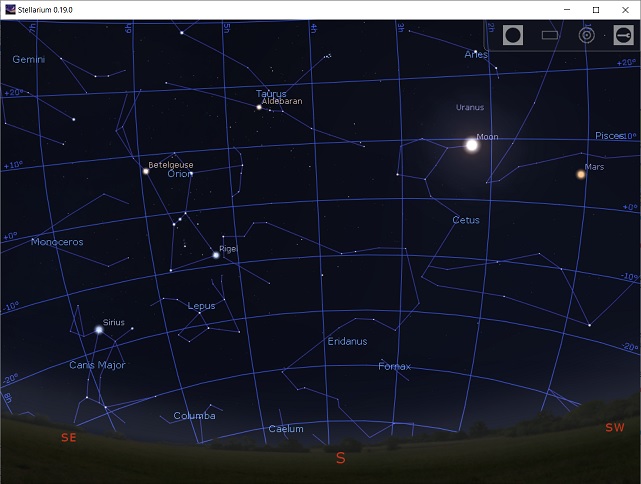
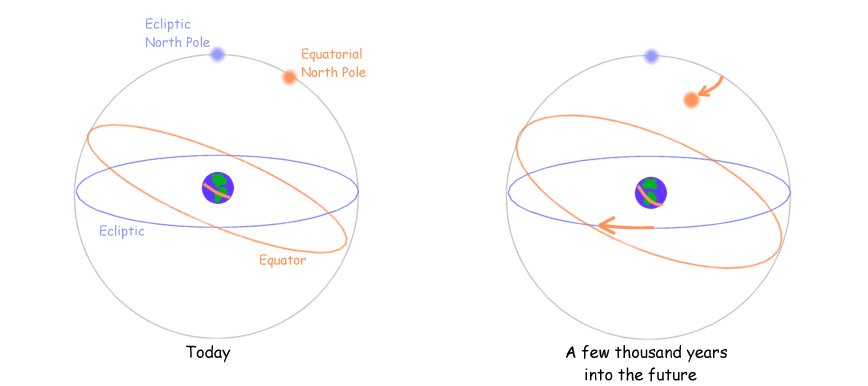
This involves knowing where to look relative to the stars. Most stars maintain fixed positions relative to each other. Even if they are moving through space relative to each other, they are so far away that this motion is not significantly visible to us. The Earth, on the other hand, rotates on its axis and revolves in its orbit. So what stars we see if we look in a certain compass direction and at a certain angle up from the horizon depends on the time of day and the position of the Earth in its orbit. So, it makes sense to anchor our sky co-ordinate systems to the stars rather than the Earth. Since, from our perspective, the sky seems to form a sphere around the Earth, a co-ordinate system similar to latitude and longitude is most useful. These co-ordinate systems do not include a third term for distance (analogous to elevation) since we are only using them to aim our line of sight on the sky, not to plan a voyage. The co-ordinate systems usually are centred on the Earth because that is where we are. Some are centred on the sun. Basically, these systems imagine that all objects in the sky are drawn on a celestial sphere surrounding the centre of view. To be clear, these co-ordinate systems give the position of the objects on the imaginary celestial sphere! As the earth rotates under this sphere, objects will change their position on your sky. A particular latitude and longitude location on the surface of the earth does not correspond to a particular celestial position. |
![]() |


![]() |
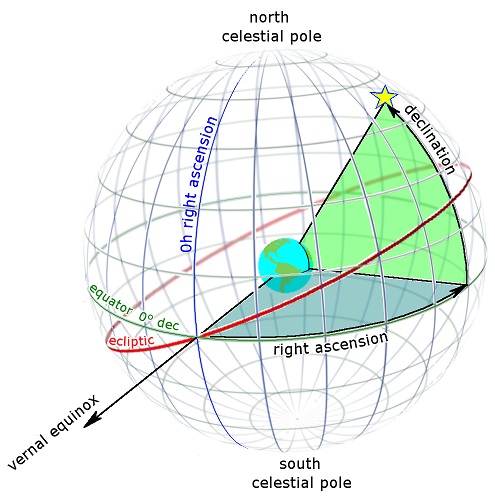
RA is shown in 1 hour increments, dec in 15o increments. The star depicted in this image is at RA 5h and dec 52o 30' The cage formed by the celestial sphere co-ordinate lines stays in a fixed orientation with respect to the stars while the Earth rotates inside it. Note: the ecliptic is the path of the sun on the celestial sphere. |
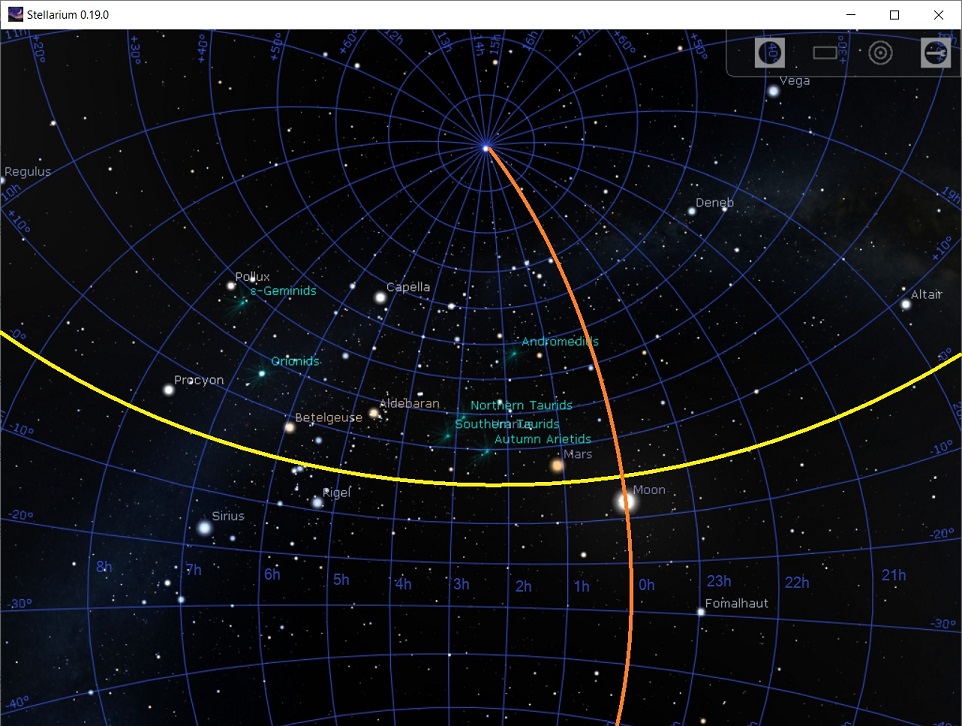
| Figure 5: Looking up from Earth's Surface at the celestial sphere. The wide angle of view increases the distortion of the co-ordinate lines. Equator (zero dec) is yellow and zero RA line is orange. From Stellarium. ![]() |
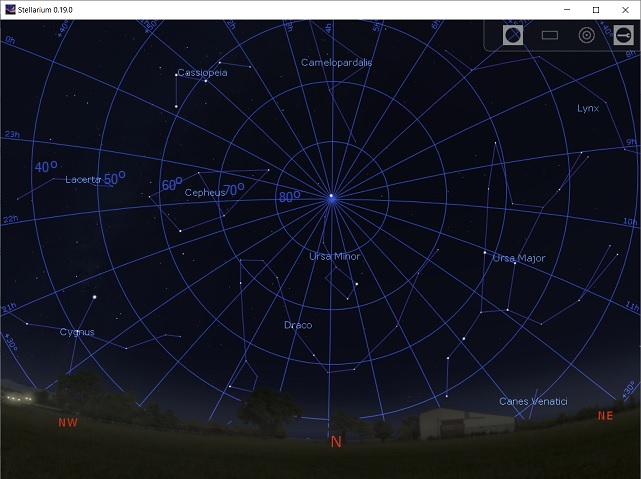
The stars and Milky Way (whitish band) will appear at the same co-ordinates each night. The moon, sun, planets, and other minor bodies within the solar system change their co-ordinates (mostly along the ecliptic) from one observation to the next. Even the stars and galaxies change their celestial co-ordinates as they and we move through space. Their distances are such that the effect of this is only apparent with very sensitive instruments and/or very long time spans between observations. As time passes over the course of a night, the Earth's west-to-east rotation will cause each star in this image will move across the sky along a path parallel to its declination line resulting in a set of concentric, counter-clockwise arcs around the north celestial pole similar to the photograph in Figure 1. The RA co-ordinate lines will move along with them. |
![]() |
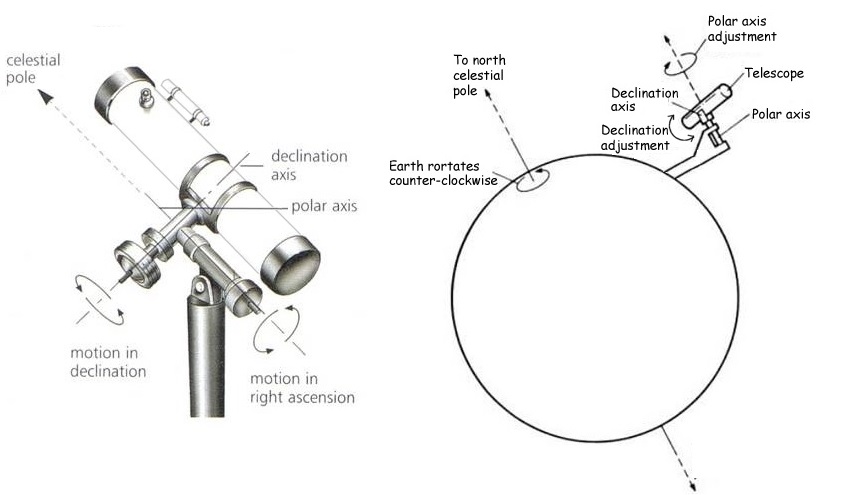
Equatorial celestial co-ordinates are mostly used for aiming telescopes rather than for unaided-eye astronomy. Telescope mounts have two perpendicular axes of rotation to aim them. The declination axis: * aims the telescope at a particular declination on the celestial sphere The polar axis: * is lined up with the north celestial pole * rotating on this axis aims the telescope at a particular RA line on the celestial sphere Once the telescope is properly aimed, it has a motor that can rotate the rest of the mount around the polar axis at the same rate as the earth rotates, but in the opposite direction. This keeps the telescope aimed at the same spot on the celestial sphere as the earth rotates. The elegance of this system is that the telescope is easy to aim and keep aimed by just one motor. |
![]() |
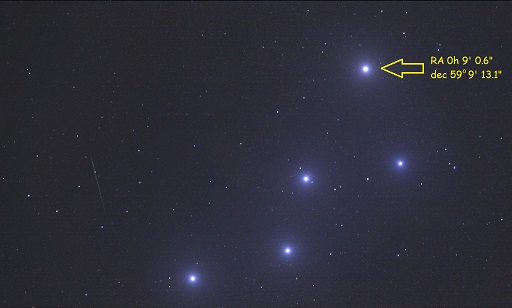
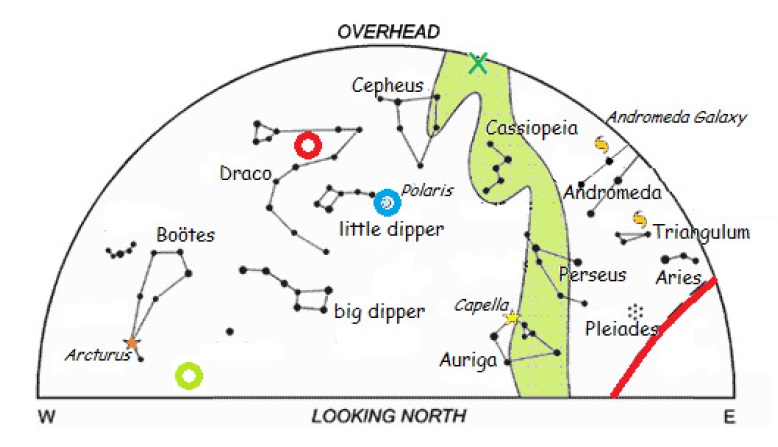
While it is easy to find the north celestial pole if you can find the little dipper, there is no easy-to-see star marking 0h RA. An easy to spot start that is reasonably close to 0h is beta Cassiopeia (the second brightest star in the constellation Cassiopeia). It is at RA 0h 09' 0.6" and dec 59o 09' 13.1". Cassiopeia looks like an "M" or a "W" depending on where it is as it circles around the north star (Polaris). One side of the "M" is a wide-open angle, the other is a narrow angle. Our target star is the end star at the narrow-angle end. Trace an arc from the north star through beta Cassiopeia and through the side of the box-shaped constellation called Pegasus (the side closest to Orion). This arc is the RA 0h line. Find Polaris, Cassiopeia, and Pegasus in Figure 5 above. Note the vertical streak to the left of the image. This probably is caused by a meteor. Measuring the RA of a star on the celestial equator when you are on Earth's equator is fairly easy. It is given by what time the star rises above the horizon relative to a star at zero RA. Imagine that you see such a star rising up from the horizon and you recognise it as being at 4h RA. Any star that rises up 59 minutes and 50 seconds later must have an RA of 5h. If you are not on the equator, you need to be really comfortable with estimating angles and with spherical trigonometry to be able to make such a determination. No matter where you are, wait until a star whose RA you know is overhead, due south, or due north of you. Draw a straight line through that star and the north or south celestial pole. All stars on that line have the same RA. |

![]() |
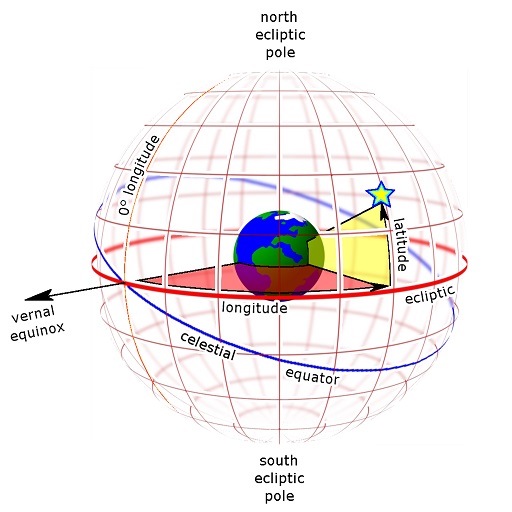
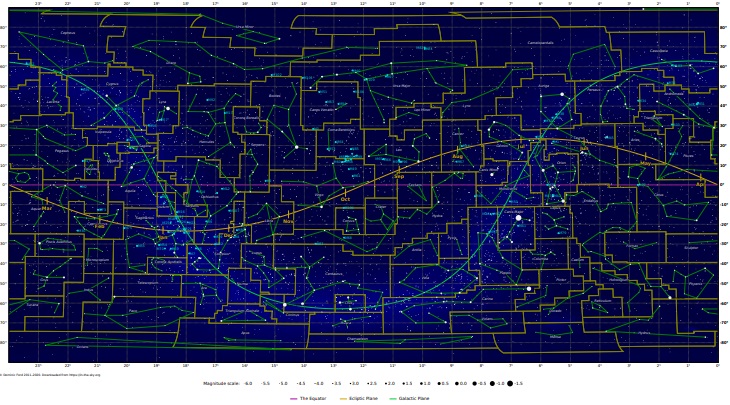
Rather than use Earth's equator and north pole as our frame of reference, we could use the plane of the ecliptic (the plane in which the Earth orbits the sun) instead. There is no particular advantage to this system over equatorial co-ordinates. The vernal equinox is still the reference for zero declination and right ascension, so precession is still a problem. Since equatorial and ecliptic celestial co-ordinates are at a small angle to each other, there is some fun math to convert between them. This system is still centred on the Earth. If we ever start moving around in the solar system in a serious way in the future, then an ecliptic co-ordinate system centred on the sun combined with a distance from the sun co-ordinate could be useful for navigation. For us earth-bound observers, ecliptic celestial co-ordinates are not of much use. |
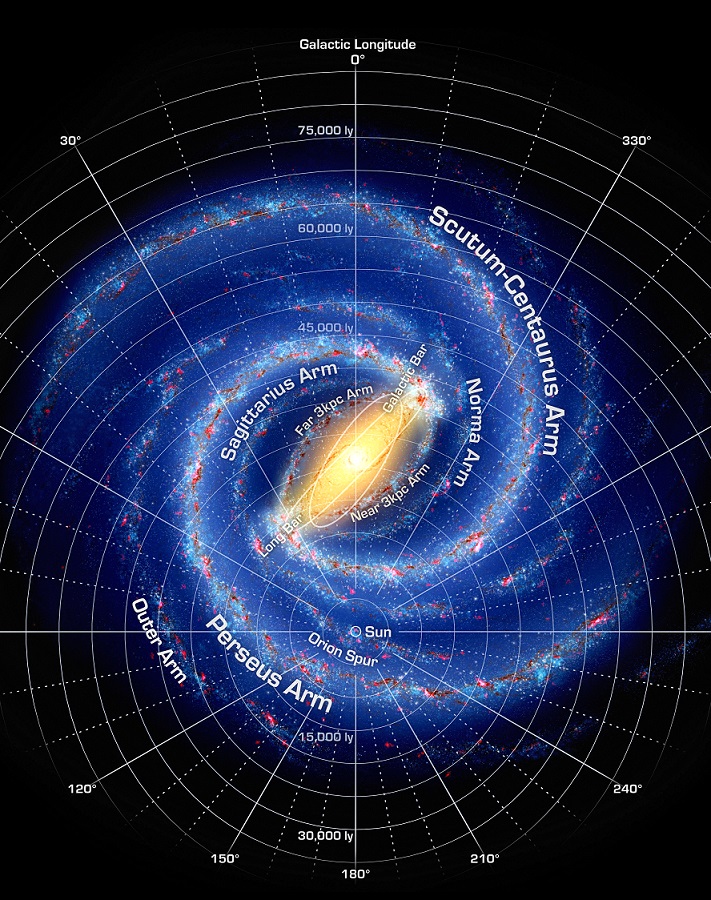
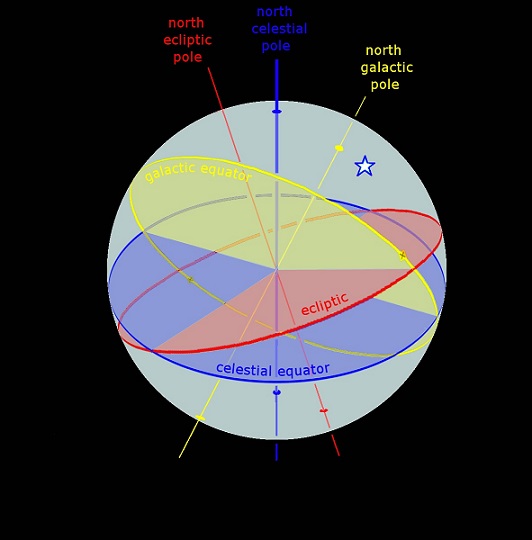
Figure 9: Galactic Celestial Co-ordinate System (still Earth-centred)![]() |
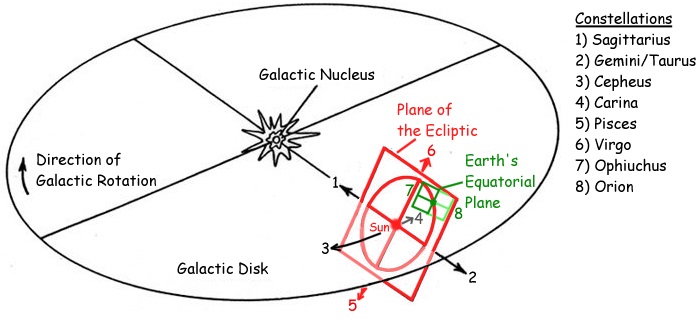
Figure 10: Plane of the Milky Way![]() Because our galaxy is very thin compared to its lateral extent, an earth-centred galactic co-ordinate system only needs to specify a direction relative to the centre of the galaxy and a distance. It is a useful system to specify where parts of the galactic disk are relative to each other. For example, it shows us the distance from our sun to the galactic centre. It also shows us that we are on the edge of a minor arm in the messy spiral structure of our galaxy. Neither of the other two systems does a good job representing the galaxy's structure because both earth's equator and the plane of the ecliptic are at very steep angles to the disk of the galaxy. How we know about this galactic structure and our place in it is a question for later in the course. |